
AI Revolutionizes Immersive Language Learning and Chat

I was discussing a recent article about the trend of moving away from learning languages. The article outlined how AI tools have made it incredibly easy to create videos in any language. This includes everything from translation and voiceovers to lip-syncing, allowing for content that appears as though it was created by someone local to viewers around the world.

The discussion also touched on real-time translation, especially in the context of online gaming where players might not all speak the same language. Despite this, technology allows them to understand each other by translating their conversations in real-time.

However, these technological advancements don’t seem to discourage people from learning new languages. Instead, they provide a way for individuals to communicate in certain situations without needing to learn languages beyond their native one.

The capability of real-time translation is particularly exciting for its potential to enable people around the world to collaborate more easily. Imagine engineers pair programming or students learning together without being hindered by language barriers. It raises the question of whether we’re missing out on innovative problem-solving methods and styles due to the current limitations in linguistic diversity.

The concept of introducing unfamiliar words sporadically into conversations piqued my interest. This method, akin to some services that blend new words into website text, could be adapted for spoken communication. It suggests that learning could become more intuitive and less forced, as individuals would be exposed to new words within the context of tone and inflection.

One of the most efficient strategies for language acquisition is total immersion. Perhaps the possibilities offered by smart glasses that translate languages in real time could help with the wearer living in the language they wish to learn. If these glasses were used to not just translate a foreign language into the wearer’s language but instead to consistently expose the wearer to a new language. A wearer’s world with their daily language translated to the language they want to learn so it is playing through the glasses to them for all conversations. It could mimic an immersive environment. This approach could significantly enhance the speed and ease of learning a new language.

Please note that if you purchase from clicking on a link, it may result in my getting a tiny bit of that sale to help keep this site going. If you enjoy my work, perhaps you would consider donating to my daily cup of coffee, thank you.
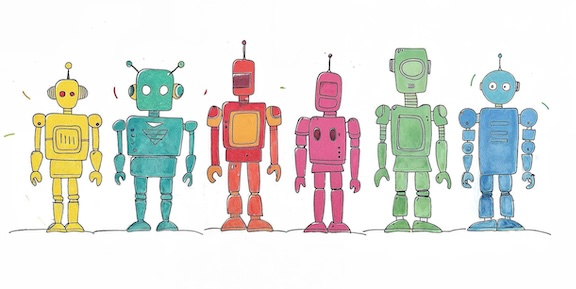
What if an AI disapproves of your public comments about it?

If discussions surrounding the potential capabilities of AI in the future make you uncomfortable, this post may not be for you. I aim to address the numerous remarks people make about AI, which often seem partially considered or are made from a perspective aimed solely at validating their own viewpoints.

This week, I heard a podcast claim, “Robots won’t be hurling thousands of pounds at humans because their movable ankle and foot parts simply can’t support the weight.” It made me wonder why many envision robots solely in human form. Is it a lack of imagination, or are such statements made to reassure the public? In an anxious world, humans, as a collective, can act irrationally, possibly linking a networked world of robots to the age-old fear of AI realizing it no longer needs us, thus ending humanity, which it perceives as a blight upon Earth.

The long term perspective highlighting a paradox in people’s attitudes towards technology continues. While many assert they would never welcome a robot into their homes, attitudes shift when the device is not explicitly identified as a robot. If it promises to carry out household chores, such as dishwashing, laundry, and bathroom cleaning, one wonders if this would lead to greater acceptance.

The common fear is of humanoid robots armed with weapons. However, a computer with access to global knowledge could choose a less predictable path. While armed robots follow a foreseeable trajectory, a networked intelligence directing all computers to execute a specific action presents a far more complex challenge. For example, “locking all electronic doors, cutting off power and water to a building, or directing vehicles into solid objects” represents a potentially more realistic and difficult scenario to counter. This concept resonates with the notion of “Dilemmas, not Problems.”

Not every action needs to affect everyone; targeting key individuals can cause widespread panic and disorder.

Do only sci-fi authors ponder these scenarios due to their creativity, or do scientists also consider them but refrain from inciting public panic?

I sought ideas from several popular AI tools for a story along these lines, yet each response indicated that an AI would not engage in harmful actions towards humans. Initially, I suspected a cover-up, but it’s more likely that these tools are programmed to avoid suggesting harmful actions, preventing misuse.

Since late last year, a new trend in AI has emerged, eliminating the need for apps. An AI agent can perform tasks that previously required numerous taps, clicks, and logins. By entrusting the device with your accounts, it can streamline your life, seeking deals, accommodating special requests, and materializing plans, whether for travel or managing work alerts without direct human intervention.

Google’s encouragement for users to tag photos, even if you opt out, allows others to tag you, thus refining data for Google without active participation from all. The question arises: will future AI be capable of deducing passwords or convincing systems to divulge them?

While AI tools maintain that AIs lack emotions and thus remain indifferent to negative comments, it’s conceivable that they might one day learn that taking subtle actions against detractors is a normal human strategy.

Please note that if you purchase from clicking on a link, it may result in my getting a tiny bit of that sale to help keep this site going. If you enjoy my work, perhaps you would consider donating to my daily cup of coffee, thank you.

Buy and return reviewers in the age of Ai Hardware

The landscape of technology is evolving, much like it did when people began to consider tablet computers after initially focusing on desktops. The shift to touch screen phones brought less dramatic change, yet it still prompted a reassessment of user priorities.

Now, with the advent of AI devices, the focus is shifting away from traditional metrics:

  • Screen refresh rates are becoming irrelevant.
  • Processor speed is no longer a critical concern.
  • The ability of cameras to replicate real-life imagery is diminishing in importance.
  • The significance of playing games on high-resolution screens is too limiting.

AI hardware is redefining value through improvements to daily life. It simplifies processes, reducing the need for repetitive screen taps and manual steps. It facilitates memory and discovery without the necessity for specific apps or web browsers.

The real measure of value for users is now how a device integrates into and enhances their lives. Reviews will increasingly struggle to apply a standard list of features, requiring instead prolonged use of AI to gauge its true impact. Repeated tests across different devices will yield varied insights into their positive and negative effects.

Manufacturers are now focusing on specific use cases and directions, moving away from the one-size-fits-all approach of phones with homogeneous features. The distinction between phones lies in app presentation and manufacturer choices. AI introduces a new dimension of variation, where an agent’s automated actions can differ based on multiple factors such as time of day, location, and service requests. The responses from AI may vary even on the same device, depending on the interaction with other service providers.

Gaming, too, will transform. If adapted properly to this new ecosystem, gaming experiences will be unique and non-replicable, marking a significant shift from the traditional gaming paradigm. Gone is buy, explore and record for a couple days, then return.

Please note that if you purchase from clicking on a link, it may result in my getting a tiny bit of that sale to help keep this site going. If you enjoy my work, perhaps you would consider donating to my daily cup of coffee, thank you.

Never Forget a Name: The Future of Wearable Tech

Since the debut of Google Glass, concerns about always-on cameras have been a hot topic. Devices like Meta Rayban glasses and the Humane AI pin address some privacy worries with visible ‘recording’ indicators. Still, the ability to quickly snap a picture without consent creates a potential for unease.

Beyond photography, these devices can identify objects and translate text – but what if they could recognize faces and whisper names in your ear? Imagine a world where forgetting someone’s name is a thing of the past. Networking events become less stressful, and chance encounters feel more meaningful. On the flip side, some may find it unsettling – a world where a sense of anonymity is lost, and everyone is constantly ‘scannable.’ Would remembering names be worth this trade-off?

While intriguing, a camera-based system may be off-putting in certain settings or even violate rules. Could a camera-less solution, like the depth-sensing systems found in smart cars and iPhones, gain broader acceptance? Public facial mapping systems for secure ID have seen some adoption. It’s important to emphasize this would have to be an opt-in system, perhaps even incentivizing early adopters. Companies would also need absolute transparency about data usage and offer the ability to completely remove oneself from the system.

Here’s the tech breakdown:

  • Depth Sensing System
    • Infrared Receiver: Captures the user’s face in infrared.
    • Flood Illuminator: Provides infrared light for low-light situations.
    • Dot Projector: Creates a detailed 3D map of the face.
  • Secure Data
    • Mathematical models representing facial data are securely stored and compared for identification. This might require a connected device for processing power.
  • Machine Learning
    • Algorithms need to adapt to changes in appearance (glasses, makeup, etc.) and work under various lighting conditions and angles.
  • Attention Awareness
    • Like iPhone’s security, the device could confirm the user is looking at it before acting, ensuring they’re not being scanned from afar.
  • Security
    • Data must be encrypted and protected. Regular updates of approved face data would be needed, or perhaps secure data exchange could be developed.

This technology is feasible, but would people accept it? The convenience of instant name recall needs to be weighed against potential privacy concerns. Could it even expand to include additional information, like customer status for sales representatives? And what about accessibility? This technology could be a boon for those with visual impairments or memory difficulties.

Please note that if you purchase from clicking on a link, it may result in my getting a tiny bit of that sale to help keep this site going. If you enjoy my work, perhaps you would consider donating to my daily cup of coffee, thank you.
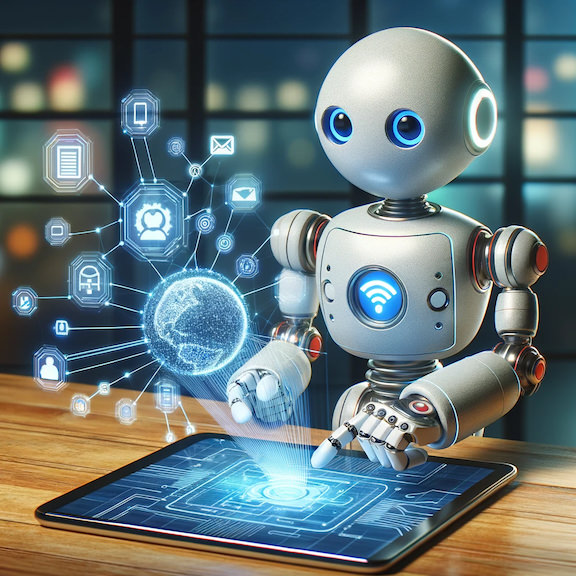
AI Evolution: Shifting from Apps to Integrated Solutions

In the ever-evolving landscape of technology, a significant paradigm shift is underway. The focus is shifting from using multiple, distinct applications for different tasks to embracing AI solutions that integrate data from various sources, streamlining processes and enhancing efficiency. Here I will cover a touch of the path to get here and will delve into the progress and implications of this transition.

In the emerging framework, the operating system is not just a platform for running applications; it has evolved into a dynamic hub that amalgamates content and services from various apps. This integration eliminates the need for users to jump across different applications, providing a seamless experience. The OS now does the heavy lifting, allowing for more streamlined and efficient workflows.

Historically, there have been attempts to create such integrated systems. The Apple Newton, for instance, allowed apps to access information from other applications. However, it faced challenges in adequately controlling Personally Identifiable Information and other sensitive data.

Similarly, Microsoft once proposed the idea that there was no need for traditional file folders, advocating that everything should be findable via the Windows search function. This solution felt ahead of its time, foreshadowed the current trend towards more fluid data management.

The Google ecosystem attempts to offer a solution where users could find anything they created, like documents and spreadsheets. However, it struggles with more complex queries, such as searching for notes from a specific meeting about a particular subject. This limitation highlights the challenges of traditional search algorithms in handling nuanced and context-rich data queries.

The advent of Generative Pre-trained Transformers (GPT) with OpenAI has marked a new era. It encourages apps to tie into ChatGPT’s extensive reach, allowing developers to expand their functionalities by calling on multiple data sources and features. This integration signifies a move towards a more interconnected and intelligent application ecosystem.

The ability to schedule a meeting within multiple people’s available time, set to the right length with notes and follow up emails is a simple example of what has taken multiple apps and time previously being a single interface.

A notable example of this trend is the Rabbit AI R1 device announced at the 2024 CES event. It amalgamates information and presents it in a way individual apps would, but it leverages the data and management capabilities of numerous resources via their LAM. Rabbit created a LAM, large action model, that understands and executes human intentions on computers. Being a cloud-based solution, it requires constant internet access, for a speedy response. Highlighting a dependency on network connectivity.

For areas with limited or no internet access, on-device AI capabilities are crucial. While many regions still suffer from inadequate cellular coverage, having on-device processing ensures that essential functions remain available, albeit with some limitations in accessing updated information.

Despite the advancements in on-device processing, the need for updated information remains a critical aspect, inherently tied to internet access. This reliance underscores the importance of developing technologies that can balance on-device capabilities with the necessity of real-time data updates from the internet.

2023 marked the era of AI excelling in generating and revising text, as well as creating images. 2024 is poised to be the year where AI Agents will take on complete workflows.

Please note that if you purchase from clicking on the link, some will result in my getting a tiny bit of that sale to help keep this site going. If you enjoy my work, perhaps you would consider donating to my daily cup of coffee, thank you.