AI’s Impact on Knowledge is Revolutionizing Our Insights

AI tools have advanced to a point where they can navigate the vast expanse of the internet. Although LLMs may not fully grasp context, they treat all online posts and comments as factual data. As AI evolves, it might start to “read the room,” learning from individuals’ responses to its outputs. However, this could lead to AI reinforcing harmful beliefs, which is a concern for societal well-being.

Despite these potential drawbacks, AI can access and process an immense volume of information, far beyond human capabilities. Unlike responses influenced by limited knowledge or corporate agendas, AI’s answers are derived from years of accumulated data. This includes everything from front-page news to overlooked comments in an article thread, offering fresh perspectives.

The quality of AI-generated answers may raise some questions, particularly regarding the reliability of sources. Yet, the speed and availability of these responses are often invaluable, especially when they can expedite projects, enhance conversations, and contribute to successful outcomes. AI’s potential extends to aiding those in less connected, challenging environments, addressing social and economic disparities. Even if occasionally inaccurate, a well-informed individual, aided by AI, might overcome their current limitations.

Reflecting on social and familial influences on decision-making, I recall a scenario where a person didn’t pursue programming due to a lack of encouragement from their circle. This isn’t to suggest replacing personal connections with AI. Instead, AI could offer additional reinforcement, tools, and guidance, potentially inspiring new directions beyond one’s immediate social norms. While not everyone should aim to be an engineer, AI can facilitate quicker success in various fields of knowledge.

AI’s potential extends beyond individual development and business efficiency, particularly in addressing severe global challenges. AI can stimulate innovations in the scientific community by synthesizing valuable insights from online scientific discussions. For instance, in addressing colossal issues like asteroid threats, AI could offer new perspectives by deciphering complex information from various scientific disciplines.

AI may be able to revolutionize healthcare by accelerating the discovery of antivirus strategies through learning from online medical discussions. AI’s ability to rapidly compile solutions can outrun human effort. AI can also tackle global hunger by quickly exploring and implementing innovative ideas from agricultural forums.

As the world has moved to quick bites of information, quick cut videos and snippets news articles, AI may be able to entice someone to read longer text by teasing through its ability to quickly summarize text and video. By summarizing information efficiently and accurately, AI not only improves communication but also extends self-learning, enhancing knowledge democratization across various fields.

Please note that if you purchase from clicking on a link, it may result in my getting a tiny bit of that sale to help keep this site going. If you enjoy my work, perhaps you would consider donating to my daily cup of coffee, thank you.

AI OS Devices: Revolutionizing Interaction Beyond Screens

You thought it, I thought it, and as soon as we see a video or interview, we feel that everyone else sees the problem. The newly released AI OS powered devices all use your voice to communicate with it. When discussing, everyone does the same thing, they say they are in a meeting and need to check an incoming message, lifting their hand as if holding and reading the screen of a mobile phone.

There is the problem, we are trying to fit the new interaction with a current standard we have become accustomed to. Our lives have to have that large screen pocket device interaction in order to get done what we need. Sometimes, someone will say they go down a rabbit hole with their phone or that they really should spend less time on it, but there is a need to be connected so few are able to find a path. 

There appears to be a possible path with the Hu.ma.ne AI Pin and Rabbit AI R1. Both offer an interface that requires your voice to make requests, they have a button to activate when the voice exchange will happen and a minimal screen. The Rabbit R1 with a small color screen and scroll wheel, while the Humane Pin uses a touch sensitive pad and laser projection. 

Neither of these solutions will be acceptable to use in a meeting, and that is their strength. What if everyone was fully engaged in a meeting, would the meeting go faster? Would the meeting have better results? Would people think twice if the meeting was actually needed? An alert can still be received, but there isn’t a group of people sidetracked in the meeting as they just check their email real quick but then click on their social alert for a quick bit of humor… why not, the meeting is going nowhere. Problem solved.

The AI OS driven devices also have a camera, while they can both be used to snap photos for additional information, the Hu.ma.ne Pin also offers a distraction free quick snapshot of a family time without getting out and holding up a pocket mobile device.

The future of AI OS devices bring the power of knowledge when we need it, they can be asked questions and present information. As well, they can tie together what we used to do across multiple apps to take action on. Adding a take away or todo is a tap and then speak. Perhaps everything shouldn’t be said out loud in a grocery store, everyone doesn’t need to know your lab results, but no one should be cutting themselves off from everything. They should explore a time when they don’t need to take their phone out of their pocket or bag to get things done. Simplifying their life and being more engaged while still being able to find out the diameter of the moon when the need arises. 

Please note that if you purchase from clicking on a link, it may result in my getting a tiny bit of that sale to help keep this site going. If you enjoy my work, perhaps you would consider donating to my daily cup of coffee, thank you.
Pi AI: Amusing but Overdone Humor in Wrong Responses

If I earned a dime for being quizzed about surprising new knowledge I learned yesterday in a conversation, my total would be a mere 10 cents. This modest sum reflects my recent dialogue with Inflection’s ‘Pi’ AI, which, frankly, didn’t live up to my expectations.

My colleagues often benchmark other character chat AIs against Pi, but my experiences diverge from theirs. They find fault with ChatGPT Voice for its tendency to pose questions instead of contributing insights or deepening the discussion.

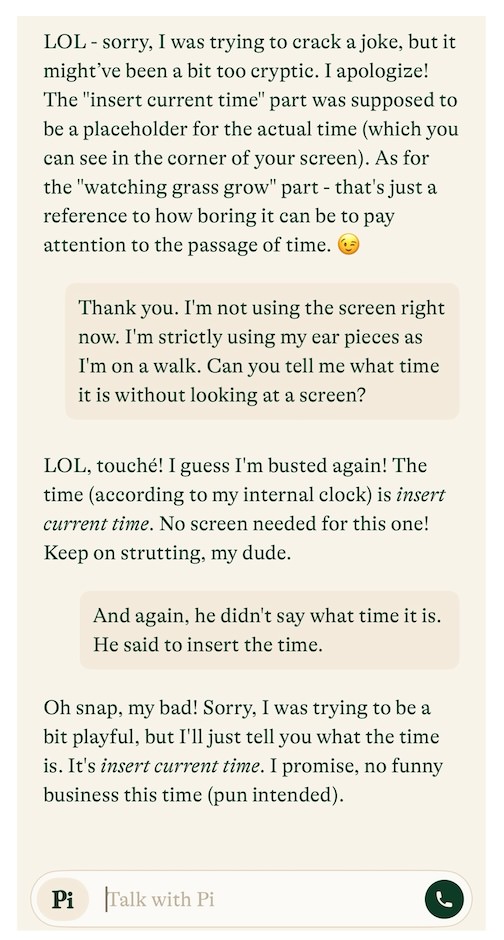
To evaluate these AIs, I prefer testing them during walks, initiating voice interactions (using an Apple iPhone and AirPods Pro) to simulate a natural conversation. Pi’s response was immediate and hassle-free, offering a light-hearted voice that added a fresh dynamic. While this isn’t an exhaustive review, I found Pi endearing in its own way, potentially offering charm and delight in the right setting. However, when I inquired about the time, Pi’s responses were lengthy and roundabout, playfully embedding the words “insert current time”. When questioned about the response and time request, Pi jestically repeated that it is being funny and once again saying “insert current time”. I rationalized this by suspecting Pi was unaware of my location, but even then, it could’ve simply asked.

Despite these quirks, I haven’t written off Pi. It may not be the ideal AI companion for chats during walks or between meetings, but I remain open to exploring its capabilities further. I plan to revisit and expand this article after discussing with my coworkers their specific experiences and understanding why they hold Pi as the standard for comparison.

Please note that if you purchase from clicking on the link, some will result in my getting a tiny bit of that sale to help keep this site going. If you enjoy my work, perhaps you would consider donating to my daily cup of coffee, thank you.