AI’s Impact on Knowledge is Revolutionizing Our Insights

AI tools have advanced to a point where they can navigate the vast expanse of the internet. Although LLMs may not fully grasp context, they treat all online posts and comments as factual data. As AI evolves, it might start to “read the room,” learning from individuals’ responses to its outputs. However, this could lead to AI reinforcing harmful beliefs, which is a concern for societal well-being.

Despite these potential drawbacks, AI can access and process an immense volume of information, far beyond human capabilities. Unlike responses influenced by limited knowledge or corporate agendas, AI’s answers are derived from years of accumulated data. This includes everything from front-page news to overlooked comments in an article thread, offering fresh perspectives.

The quality of AI-generated answers may raise some questions, particularly regarding the reliability of sources. Yet, the speed and availability of these responses are often invaluable, especially when they can expedite projects, enhance conversations, and contribute to successful outcomes. AI’s potential extends to aiding those in less connected, challenging environments, addressing social and economic disparities. Even if occasionally inaccurate, a well-informed individual, aided by AI, might overcome their current limitations.

Reflecting on social and familial influences on decision-making, I recall a scenario where a person didn’t pursue programming due to a lack of encouragement from their circle. This isn’t to suggest replacing personal connections with AI. Instead, AI could offer additional reinforcement, tools, and guidance, potentially inspiring new directions beyond one’s immediate social norms. While not everyone should aim to be an engineer, AI can facilitate quicker success in various fields of knowledge.

AI’s potential extends beyond individual development and business efficiency, particularly in addressing severe global challenges. AI can stimulate innovations in the scientific community by synthesizing valuable insights from online scientific discussions. For instance, in addressing colossal issues like asteroid threats, AI could offer new perspectives by deciphering complex information from various scientific disciplines.

AI may be able to revolutionize healthcare by accelerating the discovery of antivirus strategies through learning from online medical discussions. AI’s ability to rapidly compile solutions can outrun human effort. AI can also tackle global hunger by quickly exploring and implementing innovative ideas from agricultural forums.

As the world has moved to quick bites of information, quick cut videos and snippets news articles, AI may be able to entice someone to read longer text by teasing through its ability to quickly summarize text and video. By summarizing information efficiently and accurately, AI not only improves communication but also extends self-learning, enhancing knowledge democratization across various fields.

Please note that if you purchase from clicking on a link, it may result in my getting a tiny bit of that sale to help keep this site going. If you enjoy my work, perhaps you would consider donating to my daily cup of coffee, thank you.
Pi AI: Amusing but Overdone Humor in Wrong Responses

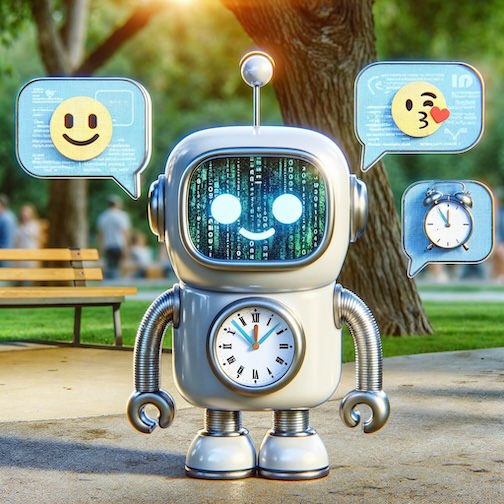
If I earned a dime for being quizzed about surprising new knowledge I learned yesterday in a conversation, my total would be a mere 10 cents. This modest sum reflects my recent dialogue with Inflection’s ‘Pi’ AI, which, frankly, didn’t live up to my expectations.

My colleagues often benchmark other character chat AIs against Pi, but my experiences diverge from theirs. They find fault with ChatGPT Voice for its tendency to pose questions instead of contributing insights or deepening the discussion.

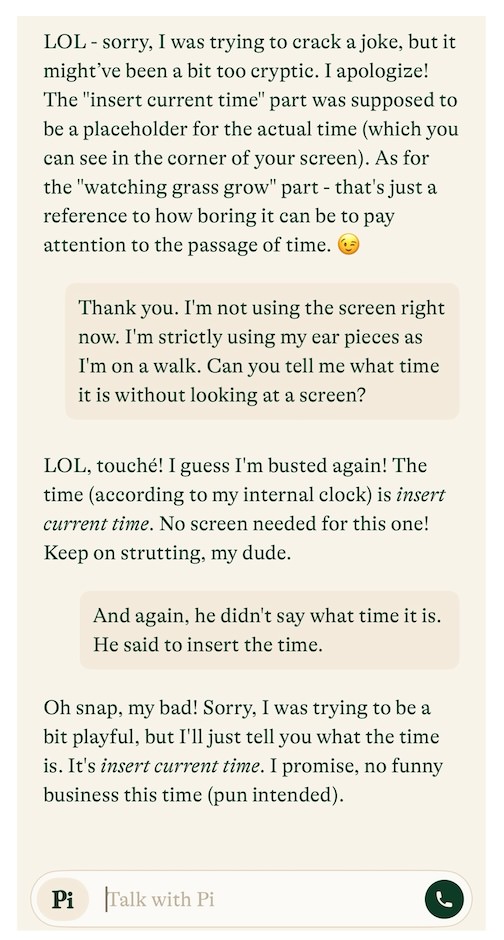
To evaluate these AIs, I prefer testing them during walks, initiating voice interactions (using an Apple iPhone and AirPods Pro) to simulate a natural conversation. Pi’s response was immediate and hassle-free, offering a light-hearted voice that added a fresh dynamic. While this isn’t an exhaustive review, I found Pi endearing in its own way, potentially offering charm and delight in the right setting. However, when I inquired about the time, Pi’s responses were lengthy and roundabout, playfully embedding the words “insert current time”. When questioned about the response and time request, Pi jestically repeated that it is being funny and once again saying “insert current time”. I rationalized this by suspecting Pi was unaware of my location, but even then, it could’ve simply asked.

Despite these quirks, I haven’t written off Pi. It may not be the ideal AI companion for chats during walks or between meetings, but I remain open to exploring its capabilities further. I plan to revisit and expand this article after discussing with my coworkers their specific experiences and understanding why they hold Pi as the standard for comparison.

Please note that if you purchase from clicking on the link, some will result in my getting a tiny bit of that sale to help keep this site going. If you enjoy my work, perhaps you would consider donating to my daily cup of coffee, thank you.
Virtual Worlds and AI: Exploring the Boundaries of Reality

There has been talk for several years that the VR and AR goggles will become glasses and even contact lenses or implants. The dream that a virtual reality of the real world could be all around the wearers. 

A limitation has been how much info a person can carry with them without being tethered to a computer, as well battery life and the speed to access the information. The last two years has brought about hardware and software making a large jump forward. Smaller compact chips that are less power hungry and able to run LLMs of data and information presentation. 

While many point back to early helmets and a world in a person’s imagination, technology is showing the imagination component is the creative part and not what is needed to step into a visual sensory environment to explore. These worlds are starting to move quicker to being overlaid in the world around a user so information and gaming is around every corner. 

For about as long as there have been computers, there has been a need to use those computers to explore the limits of the world as we know it. Generally, users frame the box they can work within to be within what they can understand. Part of the ‘what if’ is the thought that the world as we know it is actually a free running game or software test. A line of thinking that wasn’t accepted since a computer needs guidance for what an environment and its inhabitants are. Recently there have been more examples of opening the box a bit for a computer AI to build on the knowledge of the world. It is assumed that humans will keep advancing the AI technology to the point it will start exploring it’s own experiments, outside of what a human is asking for. The concern is that the AI will find humans to be a virus or will want to protect it’s creators but ends up destroying them since the system doesn’t understand a part of the human race. 

What if, instead, the AI chooses the right path to serve and protect the human race and is successful at it. To explore its thoughts on the many scenarios of its tests, the system will create use cases with human-like actors and environments similar to that which are challenged now. Trying different possible solutions, some will fail and the actors will not live a long happy life, helping the system to learn. The system can create many of these worlds to test with, each living many years in seconds of time for the computer, where the actors make decisions based on what they have to use. The system is only worried about the immediate scope of reach for the actors so it doesn’t have to build all the details of the galaxy. Some use case tests will start reaching out to the stars so that the system will expand as the actors explore and the system randomizes what could be found. With many environments, running at the same time, actors will make different decisions with different results. Some tests will fail quickly for the actors, perhaps the program lets the environment continue to run to see what can happen. There will be an almost uncountable environment tests running, all with similar starting points, to see how each will end. 

Perhaps, when people talk about the human race we know around us now, it isn’t a game simulation, rather one of near unlimited tests going on to see possible results for an outside viewer to help them decide how best to serve and protect their world.

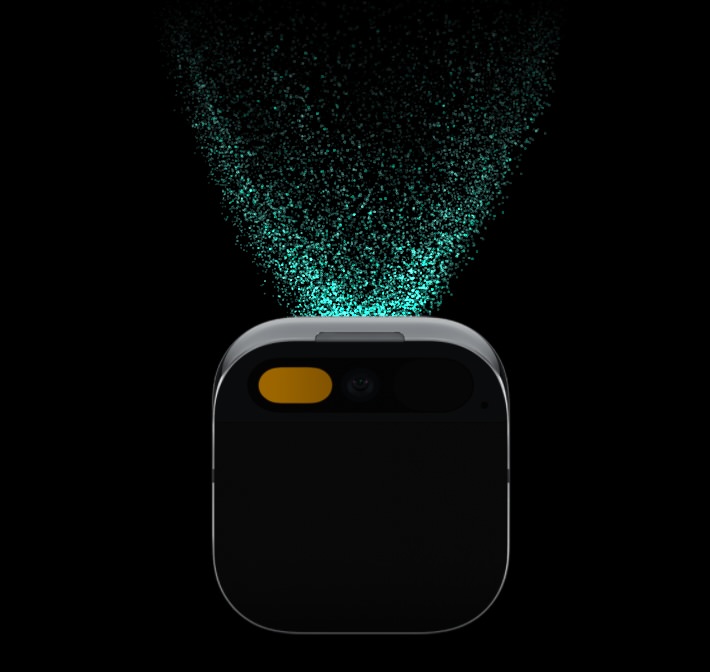
The Humane Ai Pin Personal Assistant isn’t a phone

The project captured Ai tech followers attention from its introduction at a Ted Talk. The talk was mostly a product demo rather than an outline of challenges people have in real life and a solution to make life better. Perhaps that should have been telling for someone to step up and suggest an alternate direction future product discussions should take. 

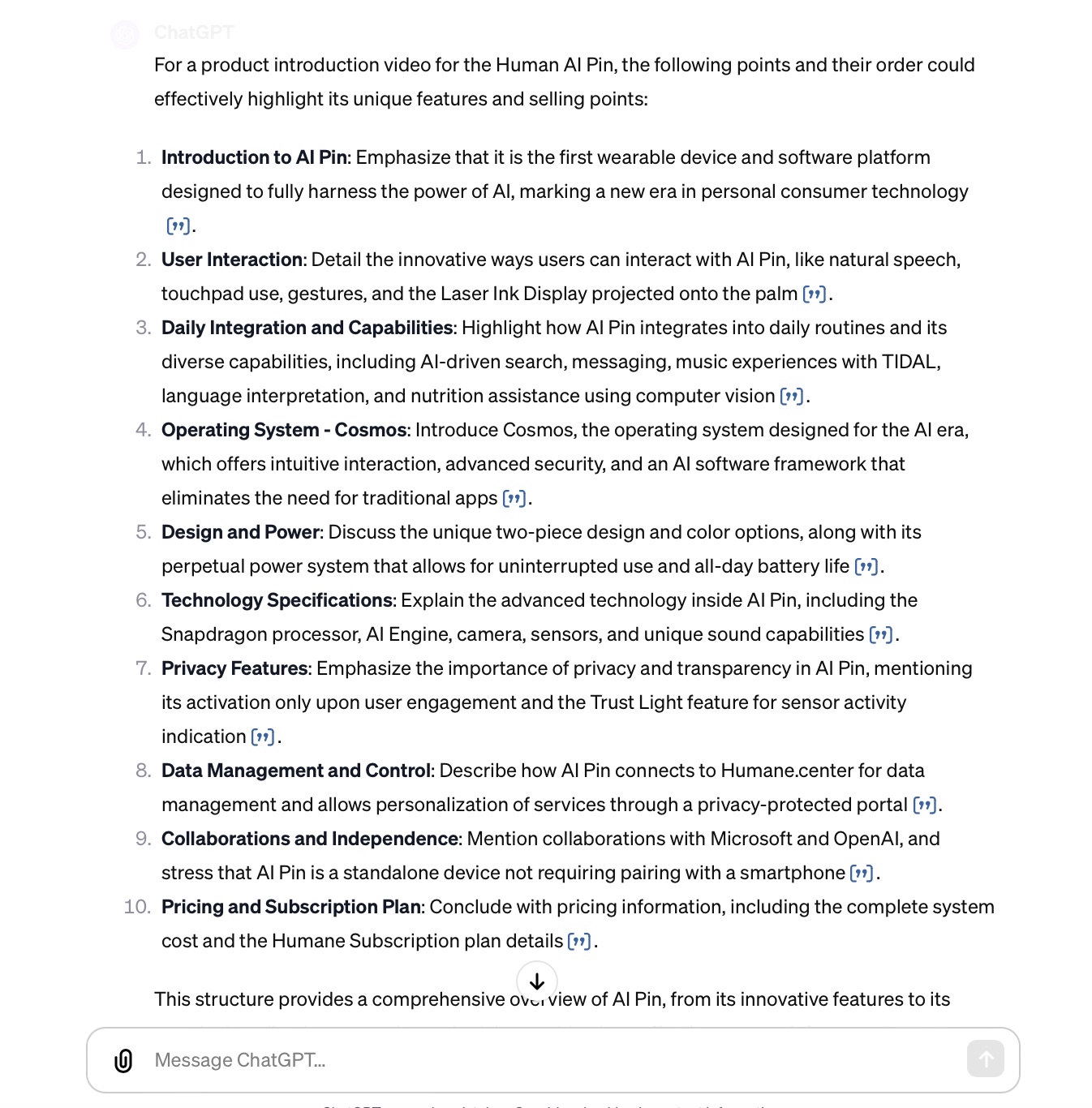
A lot of attention has been given to how the announcement on the 9th was handled, with less on how much the device would impact people’s lives. To not belabor that point, choosing to ask the Ai device the order of and the talking points of the product introduction would have helped sell the device. 

A key item that the company is leaning on is that the device/service replaces the mobile phone people carry now. This puts people into a comparison mode of thinking “yea, but can it do this thing I do with my phone”, of course since people are used to looking at their screen they can’t envision another way of getting what they need to support what they normally do by tapping on a touch screen device. 

The phrase “Personal Digital Assistant” wasn’t someone saying they were adding features to a phone, it was a device that carried information that a user needed in a small pocket device. Initially a keyboard device, then a pen entry interface and now a finger/gesture device that has onboard information as well they can reach out to the internet for additional services. The PDA was not a better phone than the one people talked with other people though, played snake and had a list of contacts on. The PDA made it possible to look up a wealth of information, have a calendar to plan a day with, and a place to jot down a note. Later, apps and internet connected features were added, soon after, people found their lives were better with a digital assistant and they wanted more.

The Humane Ai Pin is a new way of thinking to get information and have a device to improve a person’s life, but it isn’t a cell phone. There is nearly no one that has a life that allows them to talk only on speaker phone any time they need to make a call and communicate with others. Using only the device, a user would be cut off from ever getting a doctor’s call and update, the need for personal connections and updates is often the reason a phone is carried. 

Just a few thoughts of how a Humane Ai Pin could have been shown being a proactive positive impact would have: 

  • -Saying back a phone number or address someone just gave you is entered into the device’s system to use later via just speaking, no need to take a card to enter later or tap on a screen keyboard. 
  • -Asking what song is being played, then asking the pin later to play that song heard in the store around noon yesterday. 
  • -Anytime there is a message coming in, offer if it should be read out loud or shown as a laser text on the users hand seems like it is a day one needed feature but perhaps a fast follow update.
  • -Have the pin play a child’s song for the child in the parent’s arms to fall asleep or sing along with. That brings up an interesting thought, I don’t remember it being covered that there are environmental volume changes, the speaker should know the time/location of the user to not have it blast a reminder at the wrong time (whisper mode please).
  • -It wasn’t covered, does the device know where it is to give turn by turn directions to get to a meeting? 
  • -Creating a quick text and sending as a reminder are usual use cases shown by other solutions providers, making it a relatable demo.
  • -Will it work as a voice control to home automation? I thought I had seen a similar mention but am not able to find it now. Voice controlling lights is a nice demo, especially if the device is location aware so it is simply “turn on the lights”.
  • -Demoing more creative use of reminders and timers like when in a kitchen cooking.
  • -Asking the device for information about a person or location while in the car. 
  • -Reading the summary of an article or meeting notes shared with the user.
  • -For fun, asking to divide up a dinner tab amongst the group of people where the bill total is mentioned and people’s names are said too. In a small group, no one would not put their part in if a device just called out how much they owe by saying their name specifically. 
  • -I’m not providing a list of this one here, but a discussion of all of the information that could be entered and retrieved without the need of a computer and keyboard will make the usability more relatable too.

I look forward to seeing how a bold rethink of information entry and retrieval will be creatively used, but a fast run away from saying a person will be phone less because of the Humane Ai Pin is just going to have people finding all the ways they can’t do things as a reason to not buy.