The Vulnerability Loop: Why Honesty Outperforms “Expert Personas” in AI

We’ve been told to treat AI like a machine to be hacked, a servant to be commanded, or an expert to be mimicked. What if we treated it with radical honesty instead?

Rethinking Mark Manson’s Models for the AI era is an interesting exercise. At its core, Models argues that true attraction doesn’t come from cheesy pickup lines, manipulation, or trying to game the system; it comes from non-neediness, radical honesty, and vulnerability.

If you treat AI like a traditional pickup artist treats dating—using rigid, “magical” prompt hacks, trying to game the algorithm, or blindly relying on it for validation—you get superficial, robotic results. But if you approach AI with the core tenets of Models, you unlock a highly productive, authentic workflow.

Here is how to rethink the core concepts of the book for working and living with AI.

1. Non-Neediness (The Human-in-the-Loop Principal)

In Models, neediness is defined as being more invested in what others think of you than what you think of yourself.

With AI, neediness looks like intellectual dependency. It’s copy-pasting an AI’s output into an email or code repository without reviewing it, or letting a chatbot dictate your business strategy because you’re too intimidated to make the call yourself.

The Non-Needy AI User: You hold your own ground. You value your own critical thinking and domain expertise more than the AI’s smooth-sounding, confident output. You use AI to augment your thoughts, not to replace your brain.

2. Radical Honesty & Vulnerability (How You Prompt)

Manson argues that vulnerability is a form of power—admitting your flaws and desires openly cuts through the noise.

In the AI world, people often waste hours trying to craft the “perfect, professional prompt” because they are afraid of looking foolish or messy. Vulnerability with AI means stripping away the corporate fluff and admitting exactly what you don’t know.

Instead of prompting: “Act as an expert data analyst and optimize this workflow,” Try the honest approach: “I have zero experience with SQL, I’m incredibly stressed about a 4:00 PM deadline, and my data is a complete mess. Here is the raw text. Help me fix just the first step.”

By giving the AI the raw, unvarnished truth of your situation, constraints, and ignorance, it can tailor its persona and output to what you actually need, rather than what you think you should ask.

3. Screening (Filtering Outputs and Tools)

In dating, Manson suggests “screening” women quickly to see if they are a good match, rather than trying to please everyone.

With AI, you must ruthlessly screen both the tools you use and the content they generate.

  • Screening the Model: Don’t try to force a creative writing model to do heavy statistical analysis. Know when to stick with a tool and when to walk away.
  • Screening the Output: If an AI gives you a hallucinated, garbage answer, don’t spend an hour politely arguing with it to fix it. Screen it out. Delete the chat, adjust your core constraints, or switch to a different model.
Models Core ConceptOriginal Meaning (Dating)The AI Adaptation (Work & Life)
GroundednessBeing secure in your own skin and values.Having a strong foundational knowledge of your work so you can spot AI hallucinations instantly.
The Friction TheoryOvercoming anxiety and external roadblocks to connect.Overcoming the tech friction (setting up APIs, learning UI, managing information overload).
DemographicsFinding the right group of people who share your values.Matching the right AI model/agent architecture to your specific daily lifestyle or industry.
RejectionA healthy filtering mechanism to save time.Accepting that an LLM will occasionally fail, break, or give a bad output—and moving on without frustration.

An “attractive” AI collaborator doesn’t rely on tricks. They don’t download 50-page PDFs of “Secret Prompts to Get Rich.” Instead, they treat the AI as a highly capable peer. They communicate with absolute clarity, express their true intent without shame, establish firm boundaries on what tasks they will hand over, and fiercely protect their own unique human perspective.

Undertaking the challenge to do Authentic Prompting.

When you prompt out of “neediness,” you try to control the AI through rigid tricks, hidden contexts, and over-engineering. When you prompt with “vulnerability,” you state your exact situation, your current limitations, and your true intent.

The Anatomy of the Two Styles

The Needy / Tactical Style

  • The Mindset:“If I don’t use the exact magical buzzwords, the AI will give me garbage. I must trick it into being smart.”
  • The Tells:Overusing personas (“Act as a world-class expert…”), piling on generic constraints (“Make it viral, engaging, and professional”), and hiding your actual skill level.
  • The Result:Generic, hyper-polished corporate fluff that lacks soul and misses your actual goal.

The Honest / Vulnerable Style

  • The Mindset:“Here is exactly where I am stuck, here is what I know, and here is where I am completely drowning. Let’s solve this specific piece together.”
  • The Tells:Admitting confusion, specifying emotional or time constraints, providing raw/imperfect examples, and asking for collaboration rather than a finished miracle.
  • The Result:Highly tailored, deeply contextual outputs that actually cut down your workload.

Practical Scenarios in Action

Scenario 1: Tackling Project Overwhelm

You are staring at a massive project scope (like a long guide or an intensive strategy) and you don’t even know where to start.

  • The Needy / Tactical Prompt:“Act as a premium business consultant. Write a comprehensive, 10-chapter outline for a digital marketing e-book that guarantees high conversions and covers all social platforms perfectly.”
    • Why it fails: It forces the AI to generate a massive, generic template. It doesn’t solve your actual overwhelm; it just gives you a longer to-do list of generic ideas.
  • The Honest / Vulnerable Prompt:“I am trying to outline a long business e-book about community growth, but I am completely drowning in my own notes and feeling overwhelmed by the scope. Let’s ignore the big picture for a minute. I want to start just with Chapter 1, which is about organic engagement. Here is a messy brain-dump of my core ideas: [Insert raw notes]. Help me organize just this onechapter into a logical, 3-step flow that feels approachable to write.”

Scenario 2: Content Creation & Writing

You need to write a post, email, or caption, but your brain is fried and you’re out of ideas.

  • The Needy / Tactical Prompt:“Write a viral, highly engaging social media post about vintage style trends. Use psychological hooks, emojis, and a call to action to maximize comments.”
    • Why it fails: You are asking the AI to use “pickup lines” on your audience. The result will sound like an aggressive late-night infomercial or a generic marketing bot.
  • The Honest / Vulnerable Prompt:“I run a community focused on retro aesthetics, and I need to write a post for them. Honestly, my brain is fried today and I feel like I’m recycling the same three talking points. I want to give them something that feels warm and authentic, not like a sales pitch. Here is a quick description of a trend I love: [Trend details]. Give me three different conversational angles to start a genuine discussion in the comments.”

Scenario 3: Facing a Technical Roadblock

You are dealing with a software feature, design tool, or spreadsheet formula that you don’t fully understand.

  • The Needy / Tactical Prompt:“Generate an advanced, bulletproof automated workflow formula for tracking inventory margins across multiple dynamic sheets.”
    • Why it fails:You’re hiding your lack of knowledge behind big words. The AI will give you an incredibly complex solution that you won’t know how to fix or debug when it inevitably errors out.
  • The Honest / Vulnerable Prompt:“I am trying to set up a sheet to track inventory and profit margins, but spreadsheets honestly stress me out and my current layout is a bit chaotic. I don’t need anything fancy or advanced—just a simple, clear formula to calculate profit without breaking my columns if I add new rows. Here is how my columns look right now: [A: Item, B: Cost, C: Price]. Walk me through where to paste the formula like I’m a beginner.”

The Three Rules of Authentic Prompting

  1. Drop the Mask:If you don’t know what a term means, say so. If your data is a total mess, admit it. The AI doesn’t judge you; it adapts to your baseline.
  2. Isolate the Friction:Instead of asking the AI to build Rome in one prompt, tell it exactly where youare bottlenecked right now (e.g., “I have the ideas, but my tone sounds too stiff,” or “I have the data, but I don’t know how to visualize it”).
  3. Own the Final Call:Treat the AI’s first response as a rough draft from a colleague. Correct it openly: “That first point feels a little too corporate. Let’s make it sound more down-to-earth, like a friend giving advice.”


The Cognitive Cost of Convenience: Why Deep Engagement May Be One of the Best Things for Your Brain

We are living through one of the greatest “outsourcing” moments in human history.

With a few keystrokes, artificial intelligence can now help write our emails, organize our schedules, generate ideas, summarize research, and even make decisions for us. Used thoughtfully, these tools can be incredibly helpful. But cognitive scientists and educators are increasingly recognizing an important distinction: AI can either act as a scaffold that supports our thinking, or as a surrogate that replaces it entirely.

That difference matters more than most people realize.

When we consistently outsource difficult mental work to automated systems, we also reduce the kinds of cognitive effort that help keep the brain adaptable, resilient, and engaged over time. The issue is not technology itself. The issue is what happens when convenience quietly removes the healthy mental friction our brains actually need.

Psychologists use the term “desirable difficulties” to describe challenges that make learning or problem-solving harder in the short term but far more beneficial in the long term. Effortful recall, experimentation, planning, troubleshooting, and creative decision-making all force the brain to actively construct knowledge instead of passively receiving it. In other words, struggle is not always a flaw in the process. Sometimes the struggle is the process.

Research suggests that when we rely too heavily on automation for thinking tasks, we risk reducing deep cognitive engagement. We begin spending more time verifying outputs than generating original thought ourselves. Information is increasingly stored externally, which can weaken memory formation and reduce opportunities for synthesis, reflection, and independent reasoning. Much like muscles weaken from disuse, mental skills can soften when they are rarely exercised.

This does not mean everyone needs to start a side business or become an entrepreneur. The deeper point is not commerce, it is engagement.

.

A personal business simply happens to combine many cognitively rich activities at once: problem-solving, creativity, social interaction, planning, physical movement, adaptability, and emotional investment. But many deeply immersive hobbies can create similar benefits when they actively challenge the mind and involve meaningful participation rather than passive consumption.

Restoring vintage cars, woodworking, gardening, painting, sewing, photography, playing music, collecting antiques, designing miniatures, rebuilding cameras, writing, cooking elaborate meals, or even running a highly engaged community group can all demand sustained attention, creativity, learning, and real-world problem-solving.

The common thread is not productivity for profit. It is active engagement with complexity.

The brain appears to benefit most when we move beyond passive consumption and into activities that require us to think, adapt, create, and interact with the physical and social world around us.

People often talk about crossword puzzles or brain games as ways to stay mentally sharp, and while those activities certainly have value, they are often relatively closed systems with predictable rules and limited complexity. Deeply engaging creative pursuits are something entirely different. Whether you manage a vintage booth, restore old cameras, curate collections, stage displays, garden, paint, or build furniture, you are constantly engaging multiple cognitive systems at once.

You are solving logistical problems while making aesthetic decisions. You are balancing planning, memory, customer psychology, negotiation, physical movement, and creative judgment simultaneously. You are adapting in real time as conditions change. That is not passive entertainment. It is active cognitive engagement layered across emotional, social, creative, and analytical systems.

Research into cognitive reserve suggests that mentally stimulating, socially engaging, and physically active lifestyles may help support long-term brain resilience as we age. Cognitive reserve refers to the brain’s ability to adapt and compensate over time, and studies increasingly suggest that meaningful engagement matters. Activities that combine learning, movement, social interaction, and creative problem-solving appear especially beneficial.

Consider what happens when you spend an afternoon redesigning an antique booth, rebuilding a vintage camera, restoring furniture, or planning a large garden. You are analyzing spatial relationships and visual balance while remembering details, solving problems, and making constant adjustments. You are lifting, moving, arranging, editing, evaluating, and adapting. Your brain is coordinating executive function, memory, creativity, emotional judgment, and flexibility all at once.

That level of engagement is difficult to replicate through passive screen consumption alone.

One of the hidden dangers of modern technology is not simply distraction. It is passivity. Doom-scrolling, endless content feeds, and algorithmically curated entertainment place us into a reactive state where we absorb rather than participate. Consumption becomes our default mode.

Creation works differently.

When you build, stage, repair, negotiate, curate, write, or physically solve problems, you move from passive consumption into active participation with the world around you. Research increasingly suggests that productive, socially connected, and cognitively demanding activities are associated with better emotional resilience and lower risk of cognitive decline later in life.

Even the day-to-day demands of complex hobbies and creative projects exercise what psychologists call executive function, the mental systems responsible for managing complex behavior. Staying focused despite distractions, adapting when plans fail, juggling multiple variables at once, and making rapid decisions all require the brain to remain flexible and engaged. These are not abstract skills. They are the same systems we rely on for resilience, adaptability, and independent thinking throughout life.

AI itself is not the enemy. Used thoughtfully, it can absolutely enhance creativity, organization, and productivity. The key is maintaining an active role in the process. Technology should support thinking, not replace it entirely. There is a meaningful difference between using AI to organize your ideas and allowing it to fully replace your experimentation, judgment, creative voice, and problem-solving.

The goal is collaboration, not surrender.

Perhaps the bigger lesson is that not every inconvenience needs immediate automation. Sometimes wrestling with a problem is exactly what strengthens adaptability, confidence, and mental flexibility. The goal is not maximum friction, but it may also not be maximum convenience.

As machines become increasingly capable of acting like humans, it becomes even more important that humans continue acting like humans. We are not designed for endless passivity. We are designed to build, solve, adapt, create, and engage.

A deeply engaging hobby or creative pursuit may look simple from the outside, but cognitively it can function more like cross-training for the brain. It combines creativity, movement, social interaction, strategic thinking, emotional engagement, and real-world problem-solving into one deeply human experience.

The future likely belongs not to the people who outsource all thinking to machines, but to those who learn how to use technology while still keeping their own minds fully engaged.

Modern Nonsense: A Study in Inversion & The Anatomy of the Absurd

Curiouser and curiouser… 🐇

I’ve been exploring the idea of ‘Inversion’—the ancient art of turning the world upside down to see it more clearly. These poems and images are a journey through a modern Wonderland where the lessons teach nothing, the trials have no truth, and the tea party never ends. Welcome to the quiet rebellion of noticing that things aren’t quite as ‘sane’ as they seem.*

I. The Classroom of the Un-Learned

The screen is bright, the facts are tall,

We store them up to lose them all.

The teacher speaks to empty eyes,

While thumb-tips harvest gilded lies.

The more we know, the less is true,

In libraries of “Me” and “You.”

We graduate with honors deep,

In subjects we have learned to sleep.

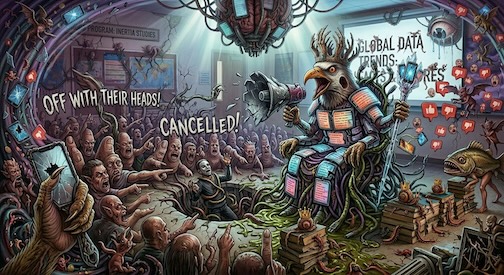
II. The Queen of No-Consequence

A thousand thumbs begin to shout,

To cast the latest villain out.

“Off with their heads!” the comments cry,

Beneath a digital, hollow sky.

The scepter’s made of plastic glass,

To watch the trending scandals pass.

A ruler bellows, grand and vast,

But has no shadow they can cast.

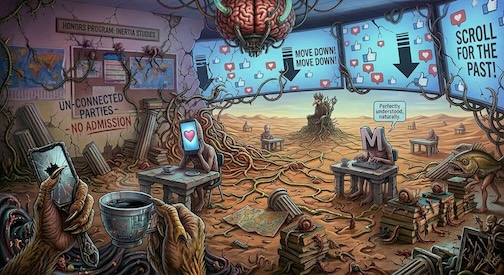
III. The Tea Party of the Disconnected

We sit at tables, miles apart,

And share the icons of a heart.

The tea is cold, the Wi-Fi’s weak,

We type the words we dare not speak.

“Move down! Move down!” the prompts command,

Across a scrollable, desert land.

A conversation, perfectly groomed,

Where everyone’s heard, but no one’s assumed.

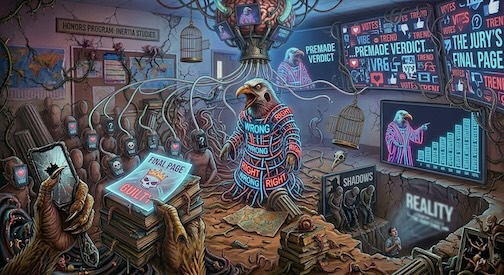
IV. The Trial of the Premade Verdict

The jury’s reached the final page,

Before the bird has left the cage.

The evidence is “Vibe” and “Trend,”

A story written at the end.

The judge is dressed in neon light,

Determining what’s “Wrong” or “Right.”

By counting votes of those who see,

The shadow, not the reality.

*Yes, full disclosure. I sorted the above out after many cycles with an AI to dig into the path and flipping it over and over again. With inspiration coming from the history of festive inversion and satirical nonsense.

The Project Whisperer: Nurturing Ideas in Team Environments

Things are changing pretty quickly out there with companies of all sizes thriving when their employees are actively engaged in generating and exploring new ideas. The need for a continuous flow of innovation is essential for staying attuned to both internal operational needs and external market demands. However, the key to successful innovation lies not just in the generation of ideas, but in fostering an environment where these ideas can be properly evaluated, refined, and implemented. While it’s crucial to encourage creativity and experimentation, it’s equally important to have robust review processes in place to ensure that the most viable and valuable ideas make it to production. I think of myself as a bit of a “project whisperer,” I’ve learned through experimentation and tuning valuable lessons about striking this delicate balance and nurturing a culture of responsible innovation within team settings.

The Challenge of Idea Implementation

Early in my career, I often found myself discouraged when my ideas were met with polite rejection: “Thanks, but I don’t think that will work for us. Keep coming up with ideas, though!” This constant pushback led me to question whether the problem lay with me, my presentation of the idea, or with the ideas themselves.

An Approach: Encouraging Others

To test this theory, I began encouraging others to develop ideas, often starting with my own as a kicking off point. I noticed that many team members struggled to generate ideas independently, it isn’t always key to places they may have worked before so it can be a new challenge. By introducing my ideas and inviting others to work on them, I created opportunities for colleagues to engage with problem-solving in a low-pressure environment.

This approach yielded multiple benefits. It provided a starting point for those who found idea generation challenging, allowing them to build upon an existing concept rather than facing the daunting task of creating something from scratch. Team members felt more confident working through problems when given an initial direction, which often led to them contributing their own unique insights and modifications. Perhaps most importantly, it fostered a collaborative atmosphere where people felt comfortable building upon and improving existing ideas.

The results were enlightening: some ideas flourished, while others faltered. Importantly, team members began to feel more comfortable contributing their own thoughts and modifications as time went on. This experience taught me a crucial lesson: success isn’t about having a 100% hit rate on ideas, but about creating an environment where ideas can be explored and refined collectively. By encouraging participation and valuing input from all team members, we created a space where innovation could thrive, regardless of where the initial spark came from.

The Reality of Idea Generation

Innovation is fundamentally a numbers game, requiring a multifaceted approach to idea cultivation. It demands a commitment to continuously generating ideas while simultaneously encouraging others to do the same. This process thrives on openness—being receptive to both your own ideas and those originating from team members. The key lies in persistent effort, working through challenges collaboratively, and understanding that each idea, whether it succeeds or not, contributes to the collective learning experience. By embracing this reality, teams can create a fertile ground for innovation where creativity flourishes and breakthroughs become possible.

The Path Forward

While only a small percentage of ideas may lead to impactful projects, the key is to keep the process alive. Encourage your team to:

  • Share ideas freely
  • Embrace the possibility of failure
  • Support each other’s creative processes
  • Celebrate both successes and learning experiences

The role of a “project whisperer” extends beyond helping with the answers. It involves cultivating an environment where ideas can take root, evolve, and occasionally, against considerable odds, blossom into groundbreaking innovations. This approach fosters a culture of creativity where every team member feels empowered to contribute, regardless of the immediate outcome. The next transformative idea may be just moments away, waiting for the right conditions to emerge.

However, fostering this culture of innovation can be challenging, especially when team members are hesitant to engage with ideas or projects that aren’t explicitly required by their job descriptions. When faced with a coworker who isn’t initiating work on a promising idea or project due to its optional nature, consider a few strategies I have used:

  1. Highlight the potential benefits: Discuss how engaging with the project could lead to personal growth, skill development, or career advancement opportunities. Frame the project as an investment in their professional future.
  2. Find alignment with current responsibilities: Help your coworker see how the project might complement or enhance their existing work. Look for ways to integrate the new idea into their regular workflow.
  3. Break it down: If the project seems overwhelming, break it into smaller, more manageable tasks. Suggest starting with a small, low-commitment aspect of the project to build momentum.
  4. Offer collaboration: Propose working on the project together. Your enthusiasm and support might be the encouragement they need to get started.
  5. Seek managerial support: If appropriate, discuss the project’s potential value with a manager. They might be able to allocate official time or resources to the project, making it easier for your coworker to justify their involvement.
  6. Create a safe space for experimentation: Emphasize that the goal is to learn and innovate, not to achieve perfection. Ensure that there’s no penalty for trying new things, even if they don’t always succeed.
  7. Recognize and reward initiative: Publicly acknowledge team members who take on optional projects. This can create a positive reinforcement cycle that encourages others to do the same.
  8. Be sure there is an understanding of how far a project can go before needing a company overview. Sometimes this includes the team member understand there won’t be blame or career challenges if the idea doesn’t move forward past a proof-of-concept.

Give these a try to help overcome inertia and foster a more proactive approach to innovation within your team. The goal is to create an environment where everyone feels empowered and motivated to contribute their ideas and efforts, even when it’s not explicitly part of their job description.

By maintaining this approach, you create a culture of innovation where every team member feels empowered to contribute, regardless of the outcome. After all, the next groundbreaking idea could be just around the corner.

Embracing AI as an Ideation Partner

There is no way to not discuss AI integration here too, it’s worth noting that artificial intelligence can be a valuable partner in the ideation process. When team members find themselves facing creative blocks, engaging with AI tools can generate a multitude of ideas rapidly. While not every AI-generated concept will be a perfect fit for the specific needs of the team or project, these ideas can serve as powerful catalysts, jump-starting the creative process and inspiring new directions of thought. By incorporating AI as a brainstorming tool, individuals can expand their creative horizons, overcome mental hurdles, and potentially uncover innovative solutions they might not have considered otherwise. The key is to view AI as a collaborative partner in the ideation journey, using its output as a springboard for human creativity and refinement.

Outside of my AI partner, I personally have processes that help find ideas in everyday things and occurrences. I will cover that later here, this article was already getting long.

Please note that if you purchase from clicking on a link, it may result in my getting a tiny bit of that sale to help keep this site going. If you enjoy my work, perhaps you would consider donating to my daily cup of coffee, thank you.

Unseen Guides: Exploring the Mystery of the Third Man Factor

The phenomenon known as the “Third Man Factor” or “Third Man Syndrome” is a fascinating subject that delves into the depths of human resilience and the mysteries of the mind under extreme conditions. This intriguing occurrence is described by individuals who, when facing life-threatening situations or during moments of intense stress and isolation, sense an unseen presence beside them. This presence, often perceived as a comforting or guiding figure, seems to offer encouragement, advice, or simply companionship, aiding them in overcoming seemingly insurmountable obstacles. The “Third Man” is not perceived as a hallucination in the traditional sense but rather as a very real assistance during desperate times.

The term itself gained prominence through explorers’ and adventurers’ narratives, most notably brought to public attention by John Geiger’s book, “The Third Man Factor.” Geiger’s compilation of accounts from people across various extreme environments—mountaineers, sailors lost at sea, explorers in the polar ice caps, and survivors from disaster-stricken areas—paints a compelling picture of the human psyche’s capabilities. Perhaps the most renowned instance is that of Sir Ernest Shackleton during his Antarctic expeditions. Shackleton, along with his crew, experienced the Third Man presence, describing it as an unseen companion that provided solace and strength as they navigated the harsh, icy wilderness.

Psychologists and neuroscientists have offered several theories to explain the Third Man Syndrome. One prevalent theory suggests that under extreme stress, isolation, or near-death experiences, the brain can trigger a protective psychological mechanism. This mechanism might manifest an external presence to counteract the overwhelming feelings of loneliness, despair, or fear, effectively helping the individual to cope and maintain their will to survive. It’s a testament to the human mind’s resilience and its capacity to create perceptions or entities that can offer comfort and guidance during times of dire need.

Introducing a speculative twist to the phenomenon, some have pondered whether the Third Man could represent more than just a psychological coping mechanism. In the realms of science fiction and metaphysical speculation, there’s a fascinating question: could this unseen presence be a watcher or guide from another reality or simulation? For those inclined towards beliefs in parallel universes, virtual realities, or the simulation hypothesis—the idea that our reality might itself be a sophisticated simulation—this question opens up intriguing possibilities. Could these moments of extreme human experience somehow thin the veil between dimensions or realities, allowing for interaction or observation from entities in a different existence?

This perspective ventures into the speculative and philosophical, engaging with questions about the nature of reality, consciousness, and the multiverse. It invites us to consider the possibility that the Third Man is not just a figment of the mind’s stress-induced imaginations but could also be a manifestation of our connection to a broader, perhaps infinitely complex, cosmos. Whether these experiences are purely internal or have external connections to other realms or consciousnesses, they underscore the profound mystery of human perception and the unexplored frontiers of the mind.

Ultimately, whether viewed through the lens of psychology, spirituality, or speculative science, the Third Man Factor remains a compelling narrative about human endurance, the power of the mind, and the unseen forces that may guide us in our darkest hours. It’s a reminder of the depth of the human spirit and the mysteries that still elude our understanding, inviting us to keep questioning and exploring the unknown territories of our existence.

Please note that if you purchase from clicking on a link, it may result in my getting a tiny bit of that sale to help keep this site going. If you enjoy my work, perhaps you would consider donating to my daily cup of coffee, thank you.

AI’s Impact on Knowledge is Revolutionizing Our Insights

AI tools have advanced to a point where they can navigate the vast expanse of the internet. Although LLMs may not fully grasp context, they treat all online posts and comments as factual data. As AI evolves, it might start to “read the room,” learning from individuals’ responses to its outputs. However, this could lead to AI reinforcing harmful beliefs, which is a concern for societal well-being.

Despite these potential drawbacks, AI can access and process an immense volume of information, far beyond human capabilities. Unlike responses influenced by limited knowledge or corporate agendas, AI’s answers are derived from years of accumulated data. This includes everything from front-page news to overlooked comments in an article thread, offering fresh perspectives.

The quality of AI-generated answers may raise some questions, particularly regarding the reliability of sources. Yet, the speed and availability of these responses are often invaluable, especially when they can expedite projects, enhance conversations, and contribute to successful outcomes. AI’s potential extends to aiding those in less connected, challenging environments, addressing social and economic disparities. Even if occasionally inaccurate, a well-informed individual, aided by AI, might overcome their current limitations.

Reflecting on social and familial influences on decision-making, I recall a scenario where a person didn’t pursue programming due to a lack of encouragement from their circle. This isn’t to suggest replacing personal connections with AI. Instead, AI could offer additional reinforcement, tools, and guidance, potentially inspiring new directions beyond one’s immediate social norms. While not everyone should aim to be an engineer, AI can facilitate quicker success in various fields of knowledge.

AI’s potential extends beyond individual development and business efficiency, particularly in addressing severe global challenges. AI can stimulate innovations in the scientific community by synthesizing valuable insights from online scientific discussions. For instance, in addressing colossal issues like asteroid threats, AI could offer new perspectives by deciphering complex information from various scientific disciplines.

AI may be able to revolutionize healthcare by accelerating the discovery of antivirus strategies through learning from online medical discussions. AI’s ability to rapidly compile solutions can outrun human effort. AI can also tackle global hunger by quickly exploring and implementing innovative ideas from agricultural forums.

As the world has moved to quick bites of information, quick cut videos and snippets news articles, AI may be able to entice someone to read longer text by teasing through its ability to quickly summarize text and video. By summarizing information efficiently and accurately, AI not only improves communication but also extends self-learning, enhancing knowledge democratization across various fields.

Please note that if you purchase from clicking on a link, it may result in my getting a tiny bit of that sale to help keep this site going. If you enjoy my work, perhaps you would consider donating to my daily cup of coffee, thank you.

Vacation Alert: Protect Family & Coworkers from Travel Scams

Traveling continues to be growing back from the pandemic time. It is smart to plan ahead, being careful when your family members and coworkers go on vacation with bad actors looking to profit via scams. A couple paths they will take to acquire money if they know an individual is on vacation is kidnapping or emergency request for money scams. I wont get into the kidnapping element, remind your folks to be mindful of where they are at and the element they are with. For a scam, you need to be sure you know it’s really the person you know who is in trouble and not a scammer, you should set up a way to check. 

If you’re looking for an AI solution since most of my recents posts are about AI, that isn’t here. Though, the following should help you if a bad actor is trying to scam you using a deep fake to mimic the traveler’s voice.

First, pick a secret word or phrase that only you, and they know. This should be a word that’s not easy for others to guess or find out. I actually like to use a conversation, or at least a couple lines dealing with a subject so that someone overhearing an early key phrase can just repeat that. This could be several back and forths that must include the weather tied into the sunny weather and the key word in that exchange. Rather than “state your keyword”.  

Next, depending on the relationship and location of travel, agree on times when they will tell you or their family that they’re okay. They could use a secure text app, email, or call to do this. It’s also a good idea to use apps that keep messages safe, like WhatsApp, Signal, or Telegram. These apps make it hard for scammers to sneak into the conversation.

It’s also smart to have important phone numbers ready, both you and the traveler should have  the local embassy or emergency numbers for the place they’re visiting. They should be careful about who they tell their travel plans to, especially on social media, because scammers will use that to convince you that they are your coworker or family member. Some folks will roll their eyes at you, but it is worth it to explain or send them links to posts for common tricks scammers use when people travel. An often forgotten planning item is a backup plan, what to do if they lose their phone, like how to reach them or they reach you in other ways.

Knowing who they are traveling with can also help. Get the full names and basic info about these people, like if they’re friends or family. It’s good to have their phone numbers or email too. Sometimes you might need to talk to these travel buddies directly, especially if something happens to them that affects the person you know.

Remember to respect everyone’s privacy and only share this info for safety. Travel friends should feel comfortable sharing their details for this reason. Having their travel plans, like where they’re staying, is also useful. Keep this information safe and only let people who really need it have it. Tell the travel buddies about your secret safety check too, in case they need to use it. They may be less careful so secret words or phrases should be their own, not the one you agreed to use with your family member or coworker.

If anyone in the group changes their travel plans., make sure to update this information. This way, you’ll always be ready to help if something goes wrong.

Please note that if you purchase from clicking on a link, it may result in my getting a tiny bit of that sale to help keep this site going. If you enjoy my work, perhaps you would consider donating to my daily cup of coffee, thank you.

Winterize Your EV: Cruise Through the Cold, Cozy and Charged

As the cold winds start to blow, signaling the approach of winter, it’s crucial for electric vehicle (EV) owners to prepare their cars for the chilly months ahead. A well-prepared EV can tackle the cold, ensuring a smooth, safe, and energy-efficient drive. Here’s how to winterize your electric vehicle to keep it performing optimally even when the mercury dips. Gone are the days of exchanging the antifreeze for the gas motor, which often spilled and negatively impacted the environment. 

One of the most fundamental steps in winterizing your EV is to check your tires and ensure they are properly inflated. Tire pressure tends to fall by one PSI for every 10-degree ambient temperature drop, which is why it’s essential to check and adjust tire pressure during cold weather. Almost all EVs will tell the driver if a tire is underinflated, but knowing how to manually check is important in case the car isn’t reporting a problem.

Depending on the typical winter conditions in your area, you might want to consider investing in winter tires, which provide better grip on icy or snowy roads due to their additional grooves compared to summer tires. EVs often use special tires for less road noise so double check what the manufacture recommends to avoid having unwanted noise inside of the car.

Maintaining visibility is crucial for safe driving, ensuring that your windshield washer fluid is topped off is necessary. A fluid rated for low temperatures will prevent freezing on the windshield. Additionally, having a good ice scraper at hand is advisable to clear icy windshields. Plan ahead, the cold morning you need it is a bad time to start looking for your scrapper.. It’s a more energy-efficient alternative to running the defroster which uses more electricity, thus conserving the battery.

Speaking of conserving battery, minimizing the use of heating in your EV is a wise practice. Unlike traditional cars with internal combustion engines that generate heat as a byproduct of the engine running, electric vehicles use electricity to generate interior heat, which can significantly drain the battery. Wearing warm clothing, such as a parka, hat, and gloves, while driving can help keep you warm without the need to turn on the heating system.

Many modern electric vehicles come with heated seats and steering wheels. Utilizing these heated accessories instead of heating the entire car is a more energy-efficient way to stay warm. These features heat the surfaces you touch, making your drive comfortable without using too much energy.

Occasionally plugging in and preconditioning your EV is another excellent way to prepare it for winter drives. Preconditioning involves turning on the heat 30 minutes to an hour before driving. This process can be initiated via a smartphone app in most modern EVs, and it helps to maximize range as no additional energy is used from the battery to warm up the interior. This is particularly beneficial for those chilly morning drives.

Battery management is another crucial aspect of winterizing your EV. Allowing the battery to warm up while attached to the charger before heading out can extend battery life. Many electric cars feature a departure mode that lets you set an exact time when you want the vehicle ready to leave, making it convenient to have your car warmed up and ready to go.

Seeking shelter for your car can also aid in keeping the batteries reasonably warm and protect it from snow and wind. If possible, parking your car in a garage or another sheltered area is advisable. However, if a snowstorm hits while your car is parked outside, keeping snow from accumulated on the car as it can affect your car’s aerodynamics, further draining the battery and posing a danger to others if it flies off your car while driving.

Winterizing your electric vehicle is not just about ensuring a smooth drive but also about maximizing battery efficiency and ensuring safety. As winter rears its head, taking these steps can prepare your EV for the cold, ensuring you continue to enjoy the benefits of electric driving in a safe and efficient manner.

Please note that if you purchase from clicking on the link, some will result in my getting a tiny bit of that sale to help keep this site going.

5 Steps: From Pushy Sales to Genuine Connections

We have all heard ABC, Always Be Closing, which translates to many as an uncomfortable ask of a customer for their purchasing of an item or service.

I was reminded this weekend of how much easier that closing is if the pitch is more natural and helps the decision being the customer’s rather than a push or forced exchange of money. It was a scarf sales person explaining how a possible Jr Sales person was only interested in a forced close. Instead, they offered a path that made the close only being the ask for payment type.

Step 1, don’t take too long picking a color/design, narrow down if they had something in mind or there is a need to point out a match to cloths or one that is popular. This will be important later so pay attention.

Step 2, get the scarf into their hands, they need to feel the texture, how soft or thick it is.

Step 3, point the individual to a mirror so they can see how the scarf will look when they try it on. Don’t say “why don’t you try it on”, rather “we have a mirror here so you can see how the scarf will look on you, it is always good to be sure how a particular scarf will fit”. This is a step that will help a live purchase happen since it can’t be done with an online shop. [My thought: Even with the AI of the future, a person can see but not feel.]

Step 4, now make the conversation a bit more personal. This shop is in San Francisco so it is a natural path to talk about the wind and how nothing but a heavy coat will keep the neck from being cold. Then the issue of what do with that heavy coat when stepping inside, a scarf is much easier to manage.

Step 5, depending on how the Step 1 went, relate back to that starting point to bring the scarf on the customer back to that point. Perhaps it hangs well and shows off the design they liked, or how well it shows off the popular style that others will notice. Sits high on the neck, or low on the shoulders are also points to mention.

Now close, while the person is still envisioning the scarf solving their problems.