The Cognitive Cost of Convenience: Why Deep Engagement May Be One of the Best Things for Your Brain

We are living through one of the greatest “outsourcing” moments in human history.

With a few keystrokes, artificial intelligence can now help write our emails, organize our schedules, generate ideas, summarize research, and even make decisions for us. Used thoughtfully, these tools can be incredibly helpful. But cognitive scientists and educators are increasingly recognizing an important distinction: AI can either act as a scaffold that supports our thinking, or as a surrogate that replaces it entirely.

That difference matters more than most people realize.

When we consistently outsource difficult mental work to automated systems, we also reduce the kinds of cognitive effort that help keep the brain adaptable, resilient, and engaged over time. The issue is not technology itself. The issue is what happens when convenience quietly removes the healthy mental friction our brains actually need.

Psychologists use the term “desirable difficulties” to describe challenges that make learning or problem-solving harder in the short term but far more beneficial in the long term. Effortful recall, experimentation, planning, troubleshooting, and creative decision-making all force the brain to actively construct knowledge instead of passively receiving it. In other words, struggle is not always a flaw in the process. Sometimes the struggle is the process.

Research suggests that when we rely too heavily on automation for thinking tasks, we risk reducing deep cognitive engagement. We begin spending more time verifying outputs than generating original thought ourselves. Information is increasingly stored externally, which can weaken memory formation and reduce opportunities for synthesis, reflection, and independent reasoning. Much like muscles weaken from disuse, mental skills can soften when they are rarely exercised.

This does not mean everyone needs to start a side business or become an entrepreneur. The deeper point is not commerce, it is engagement.

.

A personal business simply happens to combine many cognitively rich activities at once: problem-solving, creativity, social interaction, planning, physical movement, adaptability, and emotional investment. But many deeply immersive hobbies can create similar benefits when they actively challenge the mind and involve meaningful participation rather than passive consumption.

Restoring vintage cars, woodworking, gardening, painting, sewing, photography, playing music, collecting antiques, designing miniatures, rebuilding cameras, writing, cooking elaborate meals, or even running a highly engaged community group can all demand sustained attention, creativity, learning, and real-world problem-solving.

The common thread is not productivity for profit. It is active engagement with complexity.

The brain appears to benefit most when we move beyond passive consumption and into activities that require us to think, adapt, create, and interact with the physical and social world around us.

People often talk about crossword puzzles or brain games as ways to stay mentally sharp, and while those activities certainly have value, they are often relatively closed systems with predictable rules and limited complexity. Deeply engaging creative pursuits are something entirely different. Whether you manage a vintage booth, restore old cameras, curate collections, stage displays, garden, paint, or build furniture, you are constantly engaging multiple cognitive systems at once.

You are solving logistical problems while making aesthetic decisions. You are balancing planning, memory, customer psychology, negotiation, physical movement, and creative judgment simultaneously. You are adapting in real time as conditions change. That is not passive entertainment. It is active cognitive engagement layered across emotional, social, creative, and analytical systems.

Research into cognitive reserve suggests that mentally stimulating, socially engaging, and physically active lifestyles may help support long-term brain resilience as we age. Cognitive reserve refers to the brain’s ability to adapt and compensate over time, and studies increasingly suggest that meaningful engagement matters. Activities that combine learning, movement, social interaction, and creative problem-solving appear especially beneficial.

Consider what happens when you spend an afternoon redesigning an antique booth, rebuilding a vintage camera, restoring furniture, or planning a large garden. You are analyzing spatial relationships and visual balance while remembering details, solving problems, and making constant adjustments. You are lifting, moving, arranging, editing, evaluating, and adapting. Your brain is coordinating executive function, memory, creativity, emotional judgment, and flexibility all at once.

That level of engagement is difficult to replicate through passive screen consumption alone.

One of the hidden dangers of modern technology is not simply distraction. It is passivity. Doom-scrolling, endless content feeds, and algorithmically curated entertainment place us into a reactive state where we absorb rather than participate. Consumption becomes our default mode.

Creation works differently.

When you build, stage, repair, negotiate, curate, write, or physically solve problems, you move from passive consumption into active participation with the world around you. Research increasingly suggests that productive, socially connected, and cognitively demanding activities are associated with better emotional resilience and lower risk of cognitive decline later in life.

Even the day-to-day demands of complex hobbies and creative projects exercise what psychologists call executive function, the mental systems responsible for managing complex behavior. Staying focused despite distractions, adapting when plans fail, juggling multiple variables at once, and making rapid decisions all require the brain to remain flexible and engaged. These are not abstract skills. They are the same systems we rely on for resilience, adaptability, and independent thinking throughout life.

AI itself is not the enemy. Used thoughtfully, it can absolutely enhance creativity, organization, and productivity. The key is maintaining an active role in the process. Technology should support thinking, not replace it entirely. There is a meaningful difference between using AI to organize your ideas and allowing it to fully replace your experimentation, judgment, creative voice, and problem-solving.

The goal is collaboration, not surrender.

Perhaps the bigger lesson is that not every inconvenience needs immediate automation. Sometimes wrestling with a problem is exactly what strengthens adaptability, confidence, and mental flexibility. The goal is not maximum friction, but it may also not be maximum convenience.

As machines become increasingly capable of acting like humans, it becomes even more important that humans continue acting like humans. We are not designed for endless passivity. We are designed to build, solve, adapt, create, and engage.

A deeply engaging hobby or creative pursuit may look simple from the outside, but cognitively it can function more like cross-training for the brain. It combines creativity, movement, social interaction, strategic thinking, emotional engagement, and real-world problem-solving into one deeply human experience.

The future likely belongs not to the people who outsource all thinking to machines, but to those who learn how to use technology while still keeping their own minds fully engaged.
Modern Nonsense: A Study in Inversion & The Anatomy of the Absurd

Curiouser and curiouser… 🐇

I’ve been exploring the idea of ‘Inversion’—the ancient art of turning the world upside down to see it more clearly. These poems and images are a journey through a modern Wonderland where the lessons teach nothing, the trials have no truth, and the tea party never ends. Welcome to the quiet rebellion of noticing that things aren’t quite as ‘sane’ as they seem.*

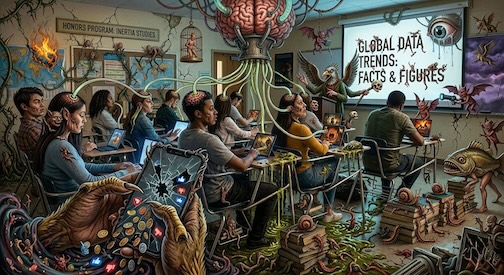
I. The Classroom of the Un-Learned

The screen is bright, the facts are tall,

We store them up to lose them all.

The teacher speaks to empty eyes,

While thumb-tips harvest gilded lies.

The more we know, the less is true,

In libraries of “Me” and “You.”

We graduate with honors deep,

In subjects we have learned to sleep.

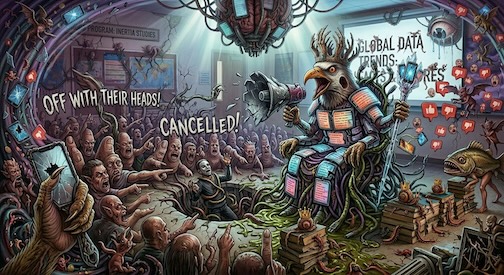
II. The Queen of No-Consequence

A thousand thumbs begin to shout,

To cast the latest villain out.

“Off with their heads!” the comments cry,

Beneath a digital, hollow sky.

The scepter’s made of plastic glass,

To watch the trending scandals pass.

A ruler bellows, grand and vast,

But has no shadow they can cast.

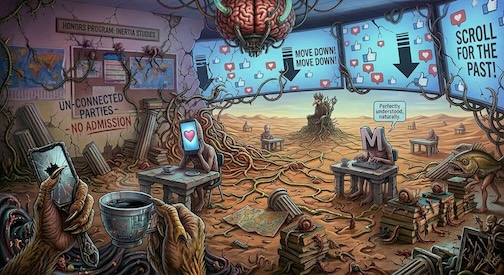
III. The Tea Party of the Disconnected

We sit at tables, miles apart,

And share the icons of a heart.

The tea is cold, the Wi-Fi’s weak,

We type the words we dare not speak.

“Move down! Move down!” the prompts command,

Across a scrollable, desert land.

A conversation, perfectly groomed,

Where everyone’s heard, but no one’s assumed.

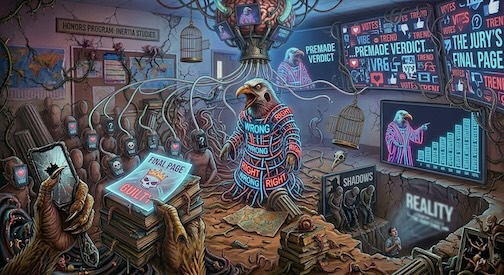
IV. The Trial of the Premade Verdict

The jury’s reached the final page,

Before the bird has left the cage.

The evidence is “Vibe” and “Trend,”

A story written at the end.

The judge is dressed in neon light,

Determining what’s “Wrong” or “Right.”

By counting votes of those who see,

The shadow, not the reality.

*Yes, full disclosure. I sorted the above out after many cycles with an AI to dig into the path and flipping it over and over again. With inspiration coming from the history of festive inversion and satirical nonsense.

We Need to Talk About How People Treat AI at Work

There’s a thread happening in tech workplaces right now that’s easy to scroll past and smile at. Someone posts a screenshot of a spicy exchange they had with their AI coding assistant. The AI pushed back on their approach, or offered an alternative they didn’t ask for, and the person responded by telling it, in no uncertain terms, what they thought of that. Then they paste the AI’s humble follow-up response and the likes roll in.

It reads as venting. Relatable frustration. A harmless bit of office humor for an era of AI tools. But sit with it a little longer, and a different set of questions starts to surface.

“They seem to be enjoying it way too much” and that enjoyment is exactly what’s worth examining.

The robot-kicking problem

In the early days of Boston Dynamics demos, footage of engineers kicking and shoving their robots went viral. It was meant to show stability under stress. But the comment sections split between “impressive engineering” and “this feels wrong” and some researchers in human-robot interaction took note. The visceral discomfort people felt wasn’t about the robot’s wellbeing. It was about what the act said about the person doing it, and about norms.

We’re in a similar moment with AI tools. The “AI can’t actually feel anything” argument is technically accurate but also a bit of a dodge. The more interesting question is: what does performing hostility toward a system especially publicly, in a work context, tell us and do to us?

Three questions worth sitting with

When someone posts their triumphant “I told the AI off” screenshot, there are really three separate phenomena that could be happening and they have very different implications.

Is this how they actually feel about pushback? AI tools like coding assistants, writing aids, and analysis tools frequently offer perspectives, alternatives, or caveats the user didn’t ask for. That can be genuinely annoying. But if the response to unsolicited suggestions is immediate contempt, it’s worth asking: is that the person’s baseline reaction to input they didn’t invite? If a junior colleague or a code reviewer offered the same feedback, would the tone be the same?

Are they “training” themselves? Behavior is practice. Every time a person responds to friction, even AI friction, with hostility and finds it satisfying (or socially rewarded, because colleagues are laughing along), that response pattern gets reinforced. The brain doesn’t cleanly segregate “how I treat systems” from “how I treat people.” Repeated behavior becomes habitual behavior. The line between venting at a tool and snapping at a coworker gets worn down, not sharpened.

What does the audience receive? The posts never show the full conversation. They show the moment of escalation and the AI’s deferential follow-up. That’s a curated narrative: I was aggressive, and I was right to be, because look it worked. Colleagues watching learn that this is an acceptable register for dealing with tools that challenge you. That norm doesn’t stay contained.

RIGHT NOW
Normalization
Hostile tone becomes the default register for frustration, shared as humor in team channels.

NEAR TERM
Behavioral drift
Patterns practiced on AI tools begin bleeding into lower-stakes human interactions.

LONG TERM
Culture shift
Teams that model contempt-as-coping lose psychological safety for honest feedback exchange.

The venting is real and valid

None of this is to say frustration with AI tools isn’t legitimate. These tools are genuinely maddening in specific ways: they hallucinate confidently, they hedge when you need directness, they add caveats when you’ve already weighed the risks, they sometimes feel like they’re managing you rather than helping you. The frustration is real.

The problem isn’t that people want to vent. It’s that they’re venting in a way that gets socially amplified in a professional setting, and with a tool that isn’t designed for that purpose which means the “release” isn’t particularly satisfying anyway, and the byproduct is a reinforced communication pattern that isn’t great.

A THOUGHT WORTH CONSIDERING

High-functioning teams treat disagreement as information. “This suggestion is wrong and here’s why” is a different cognitive act than “this suggestion is annoying and I’m going to perform my contempt for it.” One builds critical thinking. The other builds a habit of dismissal.

A constructive alternative: purpose-built directness

Many people do know you can prompt an AI tool to be as blunt and stripped-down as you need it to be. You can create a conversational mode that’s explicitly built for direct, fast, no-cushioning feedback without the social cost of performing that dynamic publicly.

If you need an avenue to cut through the friction, you can set that up directly in your first message. Something like:

EXAMPLE SYSTEM PROMPT / OPENING INSTRUCTION
For this session: be direct, skip caveats, don't offer alternatives unless I ask. If my approach is wrong, say so in one sentence. No hedging. I want responses under 3 sentences unless I specifically ask for detail. Treat this like a peer code review, not a tutorial.

This is genuinely useful. It creates a mode that serves the person who finds the default AI register too hedgy, too verbose, or too deferential. It gives them the directness they want — and keeps the interaction productive rather than just emotionally discharge-y.

You can take it further for specific use cases: a “devil’s advocate” session where the AI is instructed to argue against your approach; a “rapid fire” mode for quick factual confirmation; a “no praise” mode where it skips any positive reinforcement entirely. These are all legitimate and useful. They just look different from a screenshot posted to Slack for laughs.

What leaders and teams can do

If you’re seeing these posts in your workspace and they’re giving you a low-grade sense of unease, trust that instinct and consider making it discussable. Not as a lecture on AI ethics or robot feelings, but as a genuine conversation about communication norms and what gets modeled in public team channels.

Some concrete starting points: acknowledge that AI tools are frustrating in specific ways, and name those specifically. Model what it looks like to push back on an AI output critically rather than contemptuously “this approach won’t work because X” instead of “this is garbage.” And if you see the screenshots circulating, it’s okay to gently ask: “what was the actual problem with the output?” That shifts the frame from performance to analysis.

The people posting these aren’t villains. They’re doing what humans do finding social currency in shared frustration, testing the edges of new tools, and occasionally mistaking discharge for relief. The question is whether teams want to let that drift unchecked, or shape it into something that actually serves the people doing it.

The bar for how we treat systems that talk back to us is setting a floor for how we treat people who do the same.

The bigger picture

AI tools in the workplace aren’t going away, and neither is the friction that comes with them. The organizations that figure out how to engage with these tools critically with rigor rather than contempt, with calibrated directness rather than performed hostility are going to build better habits all around.

The Slack posts are a small signal, but they’re pointing at something real: we haven’t collectively worked out what a healthy, honest, professional relationship with AI tools looks like. We’re in the middle of figuring it out in real time, in public, with our colleagues watching.

That’s actually a pretty good reason to be thoughtful about what we’re modeling.

This post is intended as a starting point for team discussion, adapt it freely for your org’s context.