
We Need to Talk About How People Treat AI at Work

There’s a thread happening in tech workplaces right now that’s easy to scroll past and smile at. Someone posts a screenshot of a spicy exchange they had with their AI coding assistant. The AI pushed back on their approach, or offered an alternative they didn’t ask for, and the person responded by telling it, in no uncertain terms, what they thought of that. Then they paste the AI’s humble follow-up response and the likes roll in.

It reads as venting. Relatable frustration. A harmless bit of office humor for an era of AI tools. But sit with it a little longer, and a different set of questions starts to surface.

“They seem to be enjoying it way too much” and that enjoyment is exactly what’s worth examining.

The robot-kicking problem

In the early days of Boston Dynamics demos, footage of engineers kicking and shoving their robots went viral. It was meant to show stability under stress. But the comment sections split between “impressive engineering” and “this feels wrong” and some researchers in human-robot interaction took note. The visceral discomfort people felt wasn’t about the robot’s wellbeing. It was about what the act said about the person doing it, and about norms.

We’re in a similar moment with AI tools. The “AI can’t actually feel anything” argument is technically accurate but also a bit of a dodge. The more interesting question is: what does performing hostility toward a system especially publicly, in a work context, tell us and do to us?

Three questions worth sitting with

When someone posts their triumphant “I told the AI off” screenshot, there are really three separate phenomena that could be happening and they have very different implications.

Is this how they actually feel about pushback? AI tools like coding assistants, writing aids, and analysis tools frequently offer perspectives, alternatives, or caveats the user didn’t ask for. That can be genuinely annoying. But if the response to unsolicited suggestions is immediate contempt, it’s worth asking: is that the person’s baseline reaction to input they didn’t invite? If a junior colleague or a code reviewer offered the same feedback, would the tone be the same?

Are they “training” themselves? Behavior is practice. Every time a person responds to friction, even AI friction, with hostility and finds it satisfying (or socially rewarded, because colleagues are laughing along), that response pattern gets reinforced. The brain doesn’t cleanly segregate “how I treat systems” from “how I treat people.” Repeated behavior becomes habitual behavior. The line between venting at a tool and snapping at a coworker gets worn down, not sharpened.

What does the audience receive? The posts never show the full conversation. They show the moment of escalation and the AI’s deferential follow-up. That’s a curated narrative: I was aggressive, and I was right to be, because look it worked. Colleagues watching learn that this is an acceptable register for dealing with tools that challenge you. That norm doesn’t stay contained.

RIGHT NOW
Normalization
Hostile tone becomes the default register for frustration, shared as humor in team channels.

NEAR TERM
Behavioral drift
Patterns practiced on AI tools begin bleeding into lower-stakes human interactions.

LONG TERM
Culture shift
Teams that model contempt-as-coping lose psychological safety for honest feedback exchange.

The venting is real and valid

None of this is to say frustration with AI tools isn’t legitimate. These tools are genuinely maddening in specific ways: they hallucinate confidently, they hedge when you need directness, they add caveats when you’ve already weighed the risks, they sometimes feel like they’re managing you rather than helping you. The frustration is real.

The problem isn’t that people want to vent. It’s that they’re venting in a way that gets socially amplified in a professional setting, and with a tool that isn’t designed for that purpose which means the “release” isn’t particularly satisfying anyway, and the byproduct is a reinforced communication pattern that isn’t great.

A THOUGHT WORTH CONSIDERING

High-functioning teams treat disagreement as information. “This suggestion is wrong and here’s why” is a different cognitive act than “this suggestion is annoying and I’m going to perform my contempt for it.” One builds critical thinking. The other builds a habit of dismissal.

A constructive alternative: purpose-built directness

Many people do know you can prompt an AI tool to be as blunt and stripped-down as you need it to be. You can create a conversational mode that’s explicitly built for direct, fast, no-cushioning feedback without the social cost of performing that dynamic publicly.

If you need an avenue to cut through the friction, you can set that up directly in your first message. Something like:

EXAMPLE SYSTEM PROMPT / OPENING INSTRUCTION
For this session: be direct, skip caveats, don't offer alternatives unless I ask. If my approach is wrong, say so in one sentence. No hedging. I want responses under 3 sentences unless I specifically ask for detail. Treat this like a peer code review, not a tutorial.

This is genuinely useful. It creates a mode that serves the person who finds the default AI register too hedgy, too verbose, or too deferential. It gives them the directness they want — and keeps the interaction productive rather than just emotionally discharge-y.

You can take it further for specific use cases: a “devil’s advocate” session where the AI is instructed to argue against your approach; a “rapid fire” mode for quick factual confirmation; a “no praise” mode where it skips any positive reinforcement entirely. These are all legitimate and useful. They just look different from a screenshot posted to Slack for laughs.

What leaders and teams can do

If you’re seeing these posts in your workspace and they’re giving you a low-grade sense of unease, trust that instinct and consider making it discussable. Not as a lecture on AI ethics or robot feelings, but as a genuine conversation about communication norms and what gets modeled in public team channels.

Some concrete starting points: acknowledge that AI tools are frustrating in specific ways, and name those specifically. Model what it looks like to push back on an AI output critically rather than contemptuously “this approach won’t work because X” instead of “this is garbage.” And if you see the screenshots circulating, it’s okay to gently ask: “what was the actual problem with the output?” That shifts the frame from performance to analysis.

The people posting these aren’t villains. They’re doing what humans do finding social currency in shared frustration, testing the edges of new tools, and occasionally mistaking discharge for relief. The question is whether teams want to let that drift unchecked, or shape it into something that actually serves the people doing it.

The bar for how we treat systems that talk back to us is setting a floor for how we treat people who do the same.

The bigger picture

AI tools in the workplace aren’t going away, and neither is the friction that comes with them. The organizations that figure out how to engage with these tools critically with rigor rather than contempt, with calibrated directness rather than performed hostility are going to build better habits all around.

The Slack posts are a small signal, but they’re pointing at something real: we haven’t collectively worked out what a healthy, honest, professional relationship with AI tools looks like. We’re in the middle of figuring it out in real time, in public, with our colleagues watching.

That’s actually a pretty good reason to be thoughtful about what we’re modeling.

This post is intended as a starting point for team discussion, adapt it freely for your org’s context.

WFH Help Needs to be Done Right: Less Answers, More Support

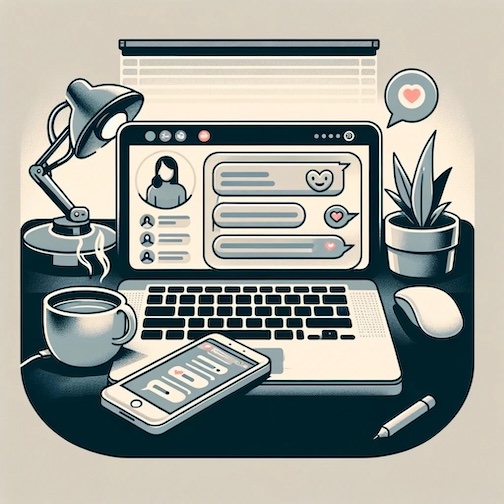
The shift to a work-from-home (WFH) culture has intricately changed the fabric of workplace interactions and communications, presenting unique challenges in how we express gratitude, engage in deep conversations, and offer help to our colleagues. Many folks in the tech industry enjoy the less distractions and zero travel time. I have been thinking about where we might need to pay attention to the human experience impact that is getting missed.

Expressing gratitude in a remote setting has become less straightforward due to the limited non-verbal cues and the over-reliance on digital communication. Without the physical presence that allows for a warm handshake or a genuine smile, messages of thanks can sometimes feel impersonal or get drowned out in the flood of emails and messages, making it harder to convey genuine appreciation.

Similarly, engaging in deep conversations has become more challenging. The spontaneous, casual interactions that naturally occur in an office environment and often lead to more meaningful discussions are rare in a remote setting. This, combined with the fatigue from constant video calls, makes individuals less inclined to engage in lengthy conversations, preferring instead to keep interactions succinct and task-focused.

When it comes to providing help, the dynamics significantly shift in a WFH environment. In an office, the ease of physically walking over to someone’s desk to offer a bit of assistance or a listening ear fosters a culture where support can be easily provided without necessarily taking over the problem-solving process. This kind of empathetic help is nuanced, aiming more to empower the colleague rather than to deliver a comprehensive solution on their behalf. It acknowledges the value of solidarity and the importance of allowing space for colleagues to navigate through challenges with guidance rather than direct intervention.

However, in a remote context, the absence of physical cues and direct observation can lead to overcompensating in attempts to support colleagues. This can manifest as providing detailed solutions rather than the partial help or empathetic support that might actually be more beneficial. The digital medium, with its demand for clarity and brevity, can sometimes prioritize efficiency over empathy, pushing individuals towards offering solutions rather than simply expressing support.

These challenges underscore the importance of adapting our communication styles and methods to maintain the human connection and supportiveness that characterize effective teamwork, even in a remote setting. Cultivating an environment that encourages clear, empathetic communication and acknowledges the nuances of remote collaboration can help mitigate these challenges, ensuring that the essence of teamwork remains strong, even when we’re apart.

Please note that if you purchase from clicking on a link, it may result in my getting a tiny bit of that sale to help keep this site going. If you enjoy my work, perhaps you would consider donating to my daily cup of coffee, thank you.

Finding New Ideas: Benefiting From Employee Innovation

Everyone knew why they were there, the meeting was clearly titled that the company needs ‘Ai’. After a brief exchange of everyone saying their version of understanding the importance, a relief is felt by all when one individual points to a text box in their offering that could use an AI Assistant to help the user with suggested text.

The suggestion goes through a Sr Management review, then a brief and off to the Engineers. The functionality work is turned around quickly, a short time for Design to do user interviews, then Marketing starts creating media around announcing their integration of AI. 

Upon release, there is a lot of buzz around the industry, driven by Sales to help expand their current agreements. Is the feature really a feature? At the minimum, is it a new use of the technology, or a bandaid on what should be rethought in general. Sales quickly hears that the user base doesn’t see a return so nothing is actually gained outside of Marketing using the announcement to get in front of the user base.

That was just a light version of most company’s with their top-down feature idea generation. Helping to make the argument why Employee-led innovation in modern corporations is important to consider. A multifaceted approach for idea generation that brings with it a blend of benefits and challenges. Bottom up ideas can spark a fresh look at possible improvements, but if not managed well, can bring disappointments too.

One of the significant advantages of employee-led innovation is the infusion of diverse ideas and perspectives. Employees from various departments and levels within the organization can offer a wide range of insights and innovative solutions that might not surface in a traditional top-down approach. This diversity in thought is crucial for fostering true innovation. As well, when employees are encouraged to innovate, they feel more valued and engaged, leading to higher job satisfaction and retention. This sense of ownership and participation can drastically improve morale and create a more committed workforce.

Another benefit is the speed of problem-solving. Employees who are directly involved in the day-to-day operations of a company often have a clearer understanding of the immediate challenges and can propose practical, innovative solutions swiftly. Cultivating an environment where innovation is encouraged at all levels can foster a culture of creativity and continuous improvement, making the company more adaptive, forward-thinking, and giving it a competitive edge in the marketplace.

However, this approach is not without its challenges. Managing and supporting a multitude of innovation projects can strain resources and requires careful coordination and oversight. There’s also an inherent risk of failure associated with innovative ideas, which can incur costs and potentially impact employee morale if not managed well. There is the potential for these employee-led initiatives to deviate from the overall strategic objectives of the company.

Ideas that are generated will need a path to present, test and review. Even if initially they appear to not be the current company direction. They may be ideas out of the normal cycle, possibly opening a new or secondary company growth path. Don’t fall into allowing a group to shut down fresh ideas because the idea doesn’t match their single view of the future. Too many quick ‘no, but keep thinking’ results in a lack of team involvement and people feel their hard work is unappreciated.

Intellectual property issues are another concern, as companies need to have clear policies regarding the ownership of ideas and inventions created by their employees to avoid legal complications. Lastly, successful employee-led innovation requires an infrastructure that supports ideation, experimentation, and implementation. Establishing and maintaining such an infrastructure can be challenging and requires commitment from all levels of the organization.

Think about the options you have to encourage the innovations, is there a reward for employees to do the thinking and creating along with their regular work efforts, do you have ongoing small chunks of time for employees to work on their ideas, or you may choose to do a once or twice a year two week heads down time to come together and develop/present ideas.

In essence, while employee-led innovation can significantly drive a company towards growth, adaptability, and employee satisfaction, it necessitates careful management, strategic alignment, and a supportive culture to be truly effective and beneficial.

Please note that if you purchase from clicking on the link, some will result in my getting a tiny bit of that sale to help keep this site going. If you enjoy my work, perhaps you would consider donating to my daily cup of coffee, thank you.