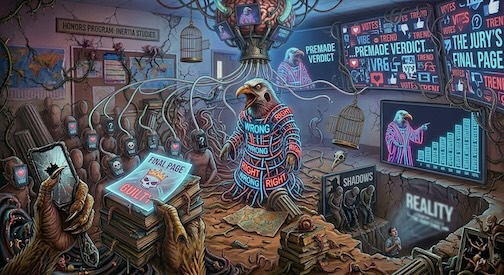
The Cognitive Cost of Convenience: Why Deep Engagement May Be One of the Best Things for Your Brain

We are living through one of the greatest “outsourcing” moments in human history.

With a few keystrokes, artificial intelligence can now help write our emails, organize our schedules, generate ideas, summarize research, and even make decisions for us. Used thoughtfully, these tools can be incredibly helpful. But cognitive scientists and educators are increasingly recognizing an important distinction: AI can either act as a scaffold that supports our thinking, or as a surrogate that replaces it entirely.

That difference matters more than most people realize.

When we consistently outsource difficult mental work to automated systems, we also reduce the kinds of cognitive effort that help keep the brain adaptable, resilient, and engaged over time. The issue is not technology itself. The issue is what happens when convenience quietly removes the healthy mental friction our brains actually need.

Psychologists use the term “desirable difficulties” to describe challenges that make learning or problem-solving harder in the short term but far more beneficial in the long term. Effortful recall, experimentation, planning, troubleshooting, and creative decision-making all force the brain to actively construct knowledge instead of passively receiving it. In other words, struggle is not always a flaw in the process. Sometimes the struggle is the process.

Research suggests that when we rely too heavily on automation for thinking tasks, we risk reducing deep cognitive engagement. We begin spending more time verifying outputs than generating original thought ourselves. Information is increasingly stored externally, which can weaken memory formation and reduce opportunities for synthesis, reflection, and independent reasoning. Much like muscles weaken from disuse, mental skills can soften when they are rarely exercised.

This does not mean everyone needs to start a side business or become an entrepreneur. The deeper point is not commerce, it is engagement.

.

A personal business simply happens to combine many cognitively rich activities at once: problem-solving, creativity, social interaction, planning, physical movement, adaptability, and emotional investment. But many deeply immersive hobbies can create similar benefits when they actively challenge the mind and involve meaningful participation rather than passive consumption.

Restoring vintage cars, woodworking, gardening, painting, sewing, photography, playing music, collecting antiques, designing miniatures, rebuilding cameras, writing, cooking elaborate meals, or even running a highly engaged community group can all demand sustained attention, creativity, learning, and real-world problem-solving.

The common thread is not productivity for profit. It is active engagement with complexity.

The brain appears to benefit most when we move beyond passive consumption and into activities that require us to think, adapt, create, and interact with the physical and social world around us.

People often talk about crossword puzzles or brain games as ways to stay mentally sharp, and while those activities certainly have value, they are often relatively closed systems with predictable rules and limited complexity. Deeply engaging creative pursuits are something entirely different. Whether you manage a vintage booth, restore old cameras, curate collections, stage displays, garden, paint, or build furniture, you are constantly engaging multiple cognitive systems at once.

You are solving logistical problems while making aesthetic decisions. You are balancing planning, memory, customer psychology, negotiation, physical movement, and creative judgment simultaneously. You are adapting in real time as conditions change. That is not passive entertainment. It is active cognitive engagement layered across emotional, social, creative, and analytical systems.

Research into cognitive reserve suggests that mentally stimulating, socially engaging, and physically active lifestyles may help support long-term brain resilience as we age. Cognitive reserve refers to the brain’s ability to adapt and compensate over time, and studies increasingly suggest that meaningful engagement matters. Activities that combine learning, movement, social interaction, and creative problem-solving appear especially beneficial.

Consider what happens when you spend an afternoon redesigning an antique booth, rebuilding a vintage camera, restoring furniture, or planning a large garden. You are analyzing spatial relationships and visual balance while remembering details, solving problems, and making constant adjustments. You are lifting, moving, arranging, editing, evaluating, and adapting. Your brain is coordinating executive function, memory, creativity, emotional judgment, and flexibility all at once.

That level of engagement is difficult to replicate through passive screen consumption alone.

One of the hidden dangers of modern technology is not simply distraction. It is passivity. Doom-scrolling, endless content feeds, and algorithmically curated entertainment place us into a reactive state where we absorb rather than participate. Consumption becomes our default mode.

Creation works differently.

When you build, stage, repair, negotiate, curate, write, or physically solve problems, you move from passive consumption into active participation with the world around you. Research increasingly suggests that productive, socially connected, and cognitively demanding activities are associated with better emotional resilience and lower risk of cognitive decline later in life.

Even the day-to-day demands of complex hobbies and creative projects exercise what psychologists call executive function, the mental systems responsible for managing complex behavior. Staying focused despite distractions, adapting when plans fail, juggling multiple variables at once, and making rapid decisions all require the brain to remain flexible and engaged. These are not abstract skills. They are the same systems we rely on for resilience, adaptability, and independent thinking throughout life.

AI itself is not the enemy. Used thoughtfully, it can absolutely enhance creativity, organization, and productivity. The key is maintaining an active role in the process. Technology should support thinking, not replace it entirely. There is a meaningful difference between using AI to organize your ideas and allowing it to fully replace your experimentation, judgment, creative voice, and problem-solving.

The goal is collaboration, not surrender.

Perhaps the bigger lesson is that not every inconvenience needs immediate automation. Sometimes wrestling with a problem is exactly what strengthens adaptability, confidence, and mental flexibility. The goal is not maximum friction, but it may also not be maximum convenience.

As machines become increasingly capable of acting like humans, it becomes even more important that humans continue acting like humans. We are not designed for endless passivity. We are designed to build, solve, adapt, create, and engage.

A deeply engaging hobby or creative pursuit may look simple from the outside, but cognitively it can function more like cross-training for the brain. It combines creativity, movement, social interaction, strategic thinking, emotional engagement, and real-world problem-solving into one deeply human experience.

The future likely belongs not to the people who outsource all thinking to machines, but to those who learn how to use technology while still keeping their own minds fully engaged.

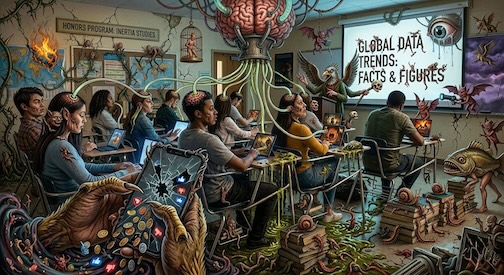
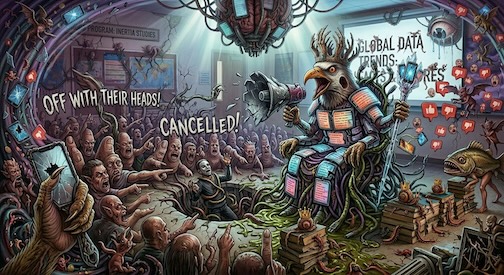
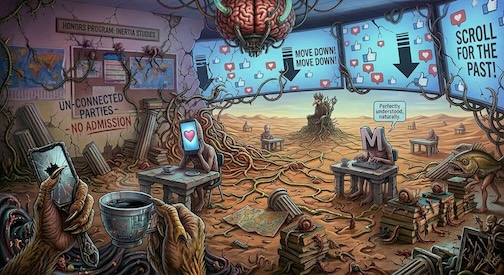
Modern Nonsense: A Study in Inversion & The Anatomy of the Absurd

Curiouser and curiouser… 🐇

I’ve been exploring the idea of ‘Inversion’—the ancient art of turning the world upside down to see it more clearly. These poems and images are a journey through a modern Wonderland where the lessons teach nothing, the trials have no truth, and the tea party never ends. Welcome to the quiet rebellion of noticing that things aren’t quite as ‘sane’ as they seem.*

I. The Classroom of the Un-Learned

The screen is bright, the facts are tall,

We store them up to lose them all.

The teacher speaks to empty eyes,

While thumb-tips harvest gilded lies.

The more we know, the less is true,

In libraries of “Me” and “You.”

We graduate with honors deep,

In subjects we have learned to sleep.

II. The Queen of No-Consequence

A thousand thumbs begin to shout,

To cast the latest villain out.

“Off with their heads!” the comments cry,

Beneath a digital, hollow sky.

The scepter’s made of plastic glass,

To watch the trending scandals pass.

A ruler bellows, grand and vast,

But has no shadow they can cast.

III. The Tea Party of the Disconnected

We sit at tables, miles apart,

And share the icons of a heart.

The tea is cold, the Wi-Fi’s weak,

We type the words we dare not speak.

“Move down! Move down!” the prompts command,

Across a scrollable, desert land.

A conversation, perfectly groomed,

Where everyone’s heard, but no one’s assumed.

IV. The Trial of the Premade Verdict

The jury’s reached the final page,

Before the bird has left the cage.

The evidence is “Vibe” and “Trend,”

A story written at the end.

The judge is dressed in neon light,

Determining what’s “Wrong” or “Right.”

By counting votes of those who see,

The shadow, not the reality.

*Yes, full disclosure. I sorted the above out after many cycles with an AI to dig into the path and flipping it over and over again. With inspiration coming from the history of festive inversion and satirical nonsense.

We Need to Talk About How People Treat AI at Work

There’s a thread happening in tech workplaces right now that’s easy to scroll past and smile at. Someone posts a screenshot of a spicy exchange they had with their AI coding assistant. The AI pushed back on their approach, or offered an alternative they didn’t ask for, and the person responded by telling it, in no uncertain terms, what they thought of that. Then they paste the AI’s humble follow-up response and the likes roll in.

It reads as venting. Relatable frustration. A harmless bit of office humor for an era of AI tools. But sit with it a little longer, and a different set of questions starts to surface.

“They seem to be enjoying it way too much” and that enjoyment is exactly what’s worth examining.

The robot-kicking problem

In the early days of Boston Dynamics demos, footage of engineers kicking and shoving their robots went viral. It was meant to show stability under stress. But the comment sections split between “impressive engineering” and “this feels wrong” and some researchers in human-robot interaction took note. The visceral discomfort people felt wasn’t about the robot’s wellbeing. It was about what the act said about the person doing it, and about norms.

We’re in a similar moment with AI tools. The “AI can’t actually feel anything” argument is technically accurate but also a bit of a dodge. The more interesting question is: what does performing hostility toward a system especially publicly, in a work context, tell us and do to us?

Three questions worth sitting with

When someone posts their triumphant “I told the AI off” screenshot, there are really three separate phenomena that could be happening and they have very different implications.

Is this how they actually feel about pushback? AI tools like coding assistants, writing aids, and analysis tools frequently offer perspectives, alternatives, or caveats the user didn’t ask for. That can be genuinely annoying. But if the response to unsolicited suggestions is immediate contempt, it’s worth asking: is that the person’s baseline reaction to input they didn’t invite? If a junior colleague or a code reviewer offered the same feedback, would the tone be the same?

Are they “training” themselves? Behavior is practice. Every time a person responds to friction, even AI friction, with hostility and finds it satisfying (or socially rewarded, because colleagues are laughing along), that response pattern gets reinforced. The brain doesn’t cleanly segregate “how I treat systems” from “how I treat people.” Repeated behavior becomes habitual behavior. The line between venting at a tool and snapping at a coworker gets worn down, not sharpened.

What does the audience receive? The posts never show the full conversation. They show the moment of escalation and the AI’s deferential follow-up. That’s a curated narrative: I was aggressive, and I was right to be, because look it worked. Colleagues watching learn that this is an acceptable register for dealing with tools that challenge you. That norm doesn’t stay contained.

RIGHT NOW
Normalization
Hostile tone becomes the default register for frustration, shared as humor in team channels.

NEAR TERM
Behavioral drift
Patterns practiced on AI tools begin bleeding into lower-stakes human interactions.

LONG TERM
Culture shift
Teams that model contempt-as-coping lose psychological safety for honest feedback exchange.

The venting is real and valid

None of this is to say frustration with AI tools isn’t legitimate. These tools are genuinely maddening in specific ways: they hallucinate confidently, they hedge when you need directness, they add caveats when you’ve already weighed the risks, they sometimes feel like they’re managing you rather than helping you. The frustration is real.

The problem isn’t that people want to vent. It’s that they’re venting in a way that gets socially amplified in a professional setting, and with a tool that isn’t designed for that purpose which means the “release” isn’t particularly satisfying anyway, and the byproduct is a reinforced communication pattern that isn’t great.

A THOUGHT WORTH CONSIDERING

High-functioning teams treat disagreement as information. “This suggestion is wrong and here’s why” is a different cognitive act than “this suggestion is annoying and I’m going to perform my contempt for it.” One builds critical thinking. The other builds a habit of dismissal.

A constructive alternative: purpose-built directness

Many people do know you can prompt an AI tool to be as blunt and stripped-down as you need it to be. You can create a conversational mode that’s explicitly built for direct, fast, no-cushioning feedback without the social cost of performing that dynamic publicly.

If you need an avenue to cut through the friction, you can set that up directly in your first message. Something like:

EXAMPLE SYSTEM PROMPT / OPENING INSTRUCTION
For this session: be direct, skip caveats, don't offer alternatives unless I ask. If my approach is wrong, say so in one sentence. No hedging. I want responses under 3 sentences unless I specifically ask for detail. Treat this like a peer code review, not a tutorial.

This is genuinely useful. It creates a mode that serves the person who finds the default AI register too hedgy, too verbose, or too deferential. It gives them the directness they want — and keeps the interaction productive rather than just emotionally discharge-y.

You can take it further for specific use cases: a “devil’s advocate” session where the AI is instructed to argue against your approach; a “rapid fire” mode for quick factual confirmation; a “no praise” mode where it skips any positive reinforcement entirely. These are all legitimate and useful. They just look different from a screenshot posted to Slack for laughs.

What leaders and teams can do

If you’re seeing these posts in your workspace and they’re giving you a low-grade sense of unease, trust that instinct and consider making it discussable. Not as a lecture on AI ethics or robot feelings, but as a genuine conversation about communication norms and what gets modeled in public team channels.

Some concrete starting points: acknowledge that AI tools are frustrating in specific ways, and name those specifically. Model what it looks like to push back on an AI output critically rather than contemptuously “this approach won’t work because X” instead of “this is garbage.” And if you see the screenshots circulating, it’s okay to gently ask: “what was the actual problem with the output?” That shifts the frame from performance to analysis.

The people posting these aren’t villains. They’re doing what humans do finding social currency in shared frustration, testing the edges of new tools, and occasionally mistaking discharge for relief. The question is whether teams want to let that drift unchecked, or shape it into something that actually serves the people doing it.

The bar for how we treat systems that talk back to us is setting a floor for how we treat people who do the same.

The bigger picture

AI tools in the workplace aren’t going away, and neither is the friction that comes with them. The organizations that figure out how to engage with these tools critically with rigor rather than contempt, with calibrated directness rather than performed hostility are going to build better habits all around.

The Slack posts are a small signal, but they’re pointing at something real: we haven’t collectively worked out what a healthy, honest, professional relationship with AI tools looks like. We’re in the middle of figuring it out in real time, in public, with our colleagues watching.

That’s actually a pretty good reason to be thoughtful about what we’re modeling.

This post is intended as a starting point for team discussion, adapt it freely for your org’s context.

The Tool Is Right There: Why We Still Don’t Use AI When We Should

You just finished a document. It looks good. You’re confident in it. You send it to a colleague for review, and they come back with a question: “Did you have Claude look at this for spelling, grammar, and punctuation? Did you ask it if you missed anything important?”

And you stop. Because the answer is no. You didn’t. Not because you don’t know how to use Claude, you use it constantly, dozens of times a day. But in that particular moment, with that particular task, you defaulted to the way you’ve always done it: send it to a human.

This isn’t a failure of knowledge. It’s a failure of habit.


It’s Not Just Work

The habit gap doesn’t stop at the office. Consider this: your HVAC system is acting up. You don’t know the model number, you’re not sure what’s wrong, and your instinct is to call someone, a repair person, a handy friend, anyone who might know. But you could take a photo of the unit, describe the symptoms to an AI, and in two minutes have the model identified, a probable cause, and a step-by-step fix. The knowledge was always accessible. The instinct to reach for it wasn’t there yet.

This is the same gap, just in a different room.


The Slack Problem

Software engineers know this pattern well. A developer hits a bug. They have access to documentation, AI coding assistants, and a dozen diagnostic tools that could help them trace the issue in minutes. Instead, they stop what they’re doing and post in Slack: “Hey, has anyone seen this before?”

There’s nothing wrong with asking teammates for help. Collaboration is valuable. But when the reach-for-Slack reflex kicks in before reaching for the available tools, something else is happening. It’s not about capability, it’s about comfort. Old workflows have gravity. They worked before, they feel safe, and they require no new thinking about how to work.

AI tools are disrupting that gravity, but slowly, because the habits underneath it were built over years, sometimes decades.


Why Habits Beat Tools

Behavioral science gives us a useful frame here. Habits are formed through repetition and reinforcement. The more times you’ve sent a draft to a colleague and gotten good feedback, the more your brain encodes that as the way you do this. A new tool, no matter how powerful, sits outside that loop until it gets pulled in deliberately.

The irony is that people who are already heavy AI users, who use Claude or similar tools constantly throughout their day, still hit this wall. The tool isn’t unfamiliar. The use case just hasn’t been wired into that specific workflow yet.

This is the core challenge for both individuals and organizations: it’s not about access, and it’s not about training. It’s about integration at the moment of decision.


What Companies and Individuals Can Do

1. Map Your Existing Workflows Before Adding AI

Most AI adoption efforts start with the tool. They should start with the workflow. Before asking “where can AI help?”, ask: “What are the steps I take every time I do this task?” Writing a document, debugging code, preparing for a meeting, each of these has an existing sequence. AI needs to be inserted into that sequence at a specific, natural point. Without that mapping, adoption stays abstract.

2. Identify the “Last Step Before Handoff” Moments

One of the highest-leverage places to insert AI is the moment just before something moves to another person. Before sending a document for human review, run it through AI first. Before escalating a bug to a teammate, describe it to an AI assistant. Before a meeting with a client, ask AI to surface what you might have missed in your prep. These “pre-handoff” checkpoints create a natural forcing function without adding friction to the workflow.

3. Make It a Team Norm, Not an Individual Choice

Individual habit change is hard. Team norms are more durable. When a team agrees — explicitly, that AI review is a standard step before peer review, it removes the ambiguity. Nobody has to decide in the moment whether to do it. It’s just part of the process, like spell-check used to become part of the process. Leaders and managers play a key role here: modeling the behavior matters as much as mandating it.

4. Start With Low-Stakes, High-Frequency Tasks

The fastest way to rewire a habit is through repetition in low-pressure situations. Identify tasks that happen often and carry little risk, drafting a short email, checking a meeting agenda, summarizing notes. Use AI consistently there first. Once the behavior is habitual in low-stakes contexts, it begins to transfer to higher-stakes ones.

5. Reframe What “Using AI” Means

There’s a lingering cultural discomfort around AI assistance that goes unspoken in many organizations. Some people feel it implies they couldn’t do the work themselves. Others worry it will be perceived that way by colleagues. This framing needs to be addressed directly. Using AI to check your work before sending it to a human reviewer isn’t a shortcut, it’s professionalism. It’s the same logic as proofreading your own writing before asking someone else to read it. The goal isn’t to replace the human in the loop. It’s to show up better prepared when you get there.


The Micro-Task Blind Spot

There’s another layer to this that rarely gets talked about: people have a mental threshold for when AI “counts” as the right tool.

Big, clear problem? Use AI. Researching a topic, drafting a long document, writing code from scratch, those feel like legitimate AI use cases. But a small snag? A moment of being stuck? A quick question you can’t quite answer? Those don’t feel big enough to warrant opening a new conversation and typing out a prompt.

That threshold is costing people hours they don’t realize they’re losing.

The real power of an AI assistant isn’t in the large, deliberate tasks. It’s in the one or two sentence moments. “I can’t remember the syntax for this.” “What’s the word I’m looking for here?” “Does this paragraph make sense?” “Why would this error occur?” These aren’t projects , they’re micro-frictions. Small points of resistance that slow you down, pull your attention sideways, or send you down a rabbit hole.

The shift isn’t learning to use AI for big things. Most people are already doing that. The shift is learning to use it the way you’d tap a knowledgeable friend on the shoulder, casually, quickly, for the small stuff too. One sentence in, one sentence out, and you’re moving again.


The Real Opportunity

The document example at the start of this piece isn’t about a missed spell-check. It’s about a missed pattern. If AI was consulted before that document went to human review, the reviewer’s time could have been spent on higher-order feedback, strategic gaps, audience fit, structural decisions, rather than catching what a machine could have caught in seconds.

That’s the real efficiency gain. Not replacing human judgment, but reserving it for the things that actually require it.

The tool is already there. The next step is making its use instinctive.


The Project Whisperer: Nurturing Ideas in Team Environments

Things are changing pretty quickly out there with companies of all sizes thriving when their employees are actively engaged in generating and exploring new ideas. The need for a continuous flow of innovation is essential for staying attuned to both internal operational needs and external market demands. However, the key to successful innovation lies not just in the generation of ideas, but in fostering an environment where these ideas can be properly evaluated, refined, and implemented. While it’s crucial to encourage creativity and experimentation, it’s equally important to have robust review processes in place to ensure that the most viable and valuable ideas make it to production. I think of myself as a bit of a “project whisperer,” I’ve learned through experimentation and tuning valuable lessons about striking this delicate balance and nurturing a culture of responsible innovation within team settings.

The Challenge of Idea Implementation

Early in my career, I often found myself discouraged when my ideas were met with polite rejection: “Thanks, but I don’t think that will work for us. Keep coming up with ideas, though!” This constant pushback led me to question whether the problem lay with me, my presentation of the idea, or with the ideas themselves.

An Approach: Encouraging Others

To test this theory, I began encouraging others to develop ideas, often starting with my own as a kicking off point. I noticed that many team members struggled to generate ideas independently, it isn’t always key to places they may have worked before so it can be a new challenge. By introducing my ideas and inviting others to work on them, I created opportunities for colleagues to engage with problem-solving in a low-pressure environment.

This approach yielded multiple benefits. It provided a starting point for those who found idea generation challenging, allowing them to build upon an existing concept rather than facing the daunting task of creating something from scratch. Team members felt more confident working through problems when given an initial direction, which often led to them contributing their own unique insights and modifications. Perhaps most importantly, it fostered a collaborative atmosphere where people felt comfortable building upon and improving existing ideas.

The results were enlightening: some ideas flourished, while others faltered. Importantly, team members began to feel more comfortable contributing their own thoughts and modifications as time went on. This experience taught me a crucial lesson: success isn’t about having a 100% hit rate on ideas, but about creating an environment where ideas can be explored and refined collectively. By encouraging participation and valuing input from all team members, we created a space where innovation could thrive, regardless of where the initial spark came from.

The Reality of Idea Generation

Innovation is fundamentally a numbers game, requiring a multifaceted approach to idea cultivation. It demands a commitment to continuously generating ideas while simultaneously encouraging others to do the same. This process thrives on openness—being receptive to both your own ideas and those originating from team members. The key lies in persistent effort, working through challenges collaboratively, and understanding that each idea, whether it succeeds or not, contributes to the collective learning experience. By embracing this reality, teams can create a fertile ground for innovation where creativity flourishes and breakthroughs become possible.

The Path Forward

While only a small percentage of ideas may lead to impactful projects, the key is to keep the process alive. Encourage your team to:

  • Share ideas freely
  • Embrace the possibility of failure
  • Support each other’s creative processes
  • Celebrate both successes and learning experiences

The role of a “project whisperer” extends beyond helping with the answers. It involves cultivating an environment where ideas can take root, evolve, and occasionally, against considerable odds, blossom into groundbreaking innovations. This approach fosters a culture of creativity where every team member feels empowered to contribute, regardless of the immediate outcome. The next transformative idea may be just moments away, waiting for the right conditions to emerge.

However, fostering this culture of innovation can be challenging, especially when team members are hesitant to engage with ideas or projects that aren’t explicitly required by their job descriptions. When faced with a coworker who isn’t initiating work on a promising idea or project due to its optional nature, consider a few strategies I have used:

  1. Highlight the potential benefits: Discuss how engaging with the project could lead to personal growth, skill development, or career advancement opportunities. Frame the project as an investment in their professional future.
  2. Find alignment with current responsibilities: Help your coworker see how the project might complement or enhance their existing work. Look for ways to integrate the new idea into their regular workflow.
  3. Break it down: If the project seems overwhelming, break it into smaller, more manageable tasks. Suggest starting with a small, low-commitment aspect of the project to build momentum.
  4. Offer collaboration: Propose working on the project together. Your enthusiasm and support might be the encouragement they need to get started.
  5. Seek managerial support: If appropriate, discuss the project’s potential value with a manager. They might be able to allocate official time or resources to the project, making it easier for your coworker to justify their involvement.
  6. Create a safe space for experimentation: Emphasize that the goal is to learn and innovate, not to achieve perfection. Ensure that there’s no penalty for trying new things, even if they don’t always succeed.
  7. Recognize and reward initiative: Publicly acknowledge team members who take on optional projects. This can create a positive reinforcement cycle that encourages others to do the same.
  8. Be sure there is an understanding of how far a project can go before needing a company overview. Sometimes this includes the team member understand there won’t be blame or career challenges if the idea doesn’t move forward past a proof-of-concept.

Give these a try to help overcome inertia and foster a more proactive approach to innovation within your team. The goal is to create an environment where everyone feels empowered and motivated to contribute their ideas and efforts, even when it’s not explicitly part of their job description.

By maintaining this approach, you create a culture of innovation where every team member feels empowered to contribute, regardless of the outcome. After all, the next groundbreaking idea could be just around the corner.

Embracing AI as an Ideation Partner

There is no way to not discuss AI integration here too, it’s worth noting that artificial intelligence can be a valuable partner in the ideation process. When team members find themselves facing creative blocks, engaging with AI tools can generate a multitude of ideas rapidly. While not every AI-generated concept will be a perfect fit for the specific needs of the team or project, these ideas can serve as powerful catalysts, jump-starting the creative process and inspiring new directions of thought. By incorporating AI as a brainstorming tool, individuals can expand their creative horizons, overcome mental hurdles, and potentially uncover innovative solutions they might not have considered otherwise. The key is to view AI as a collaborative partner in the ideation journey, using its output as a springboard for human creativity and refinement.

Outside of my AI partner, I personally have processes that help find ideas in everyday things and occurrences. I will cover that later here, this article was already getting long.

Please note that if you purchase from clicking on a link, it may result in my getting a tiny bit of that sale to help keep this site going. If you enjoy my work, perhaps you would consider donating to my daily cup of coffee, thank you.

Bad Actors Use Prescription Updates to Collect Your PHI

Most often, when we hear about a hospital or medical system getting hit by a hacker or malware to gather information, we think about credit cards or health info being used to extort money from individuals if the release of the information would be embarrassing.

Hospitals or other health agencies often downplay the significance of the information released since it isn’t as immediately harmful as social security numbers or credit card info. However, any PII and PHI can be additional data points for a group building their list to do more than simply ask for money. In mass, bad actors can compile people into groups to social engineer them or know what to say to elicit reactions to fake political and economic information.

Recently, we got a call from the store where we fill our prescriptions. The call started off sounding slightly robotic, but once we responded to one question, a human (or quality AI) came on the line. They said there was an issue with a prescription that they needed to inform us about. They asked us to confirm some personal information to ensure they were speaking to the right person. They only stated one item before asking for our DOB, address, and other details. We didn’t provide that info since they should already know it—they called us.

We said we would call them back rather than give any info. Interestingly, they didn’t give us a number to call them back or a ‘fake’ reference number. We called our local pharmacy, which confirmed there was no problem with our prescription and no record of the company calling us.

While some of these calls may be legitimate, this incident reminds us that spoofing a call from a number is easy for these individuals, and giving any info just makes their job easier. In our case, it proved to be someone attempting to gather data for malicious purposes, likely targeting a massive list due to the bot transferring the call to a human.

Please note that if you purchase from clicking on a link, it may result in my getting a tiny bit of that sale to help keep this site going. If you enjoy my work, perhaps you would consider donating to my daily cup of coffee, thank you.

Globetrotting Thieves: Beyond the Lens of ‘The Thief Collector’

In the world of cinema, it’s a given that a movie’s green light often hinges on its potential box office appeal. 

Consider, a narrative centered around a globetrotting couple. Despite a lack of visible means of support the ongoing travels, they navigate the globe, accessing regions typically closed to tourists. Their journey, documented through photographs, reveals visits to clandestine locations, often entering countries through less-than-official means that border on the need for smuggling. Over years, their life has been meticulously chronicled in a diary, notable for its gaps in time. Amidst their travels, art pieces of significant value mysteriously vanish, some resurface within their estate, captured in the background of photos and one notable piece hanging behind a door, discovered after their passing. This suggests a dramatic shift from their humble beginnings in teaching to a clandestine existence as international art thieves, indulging in the thrill of the heist and the covert delivery of treasures to a clandestine patron, funding their extravagant lifestyle before they retreat to their secluded abode and an outwardly mundane existence.

Amidst this backdrop, one of them pens a novel about infidelity within a marriage, in a chapter where a gardener, discovered to be the paramour of one’s spouse, is fatally dealt with by the aggrieved party. This cinematic endeavor, titled “The Thief Collector,” opts for a narrow focus, sidelining the rich tapestry of international intrigue for a singular, albeit sensationalized narrative thread centered on the search of the gardener’s body near the residence. This choice represents a missed opportunity, eschewing a deep dive into the myriad mysteries that envelop their lives for a storyline that, while provocative, fails to fully capture the essence of their enigmatic existence. Consequently, the film may struggle to resonate with audiences, potentially languishing in obscurity without sparking the broader conversations it might have inspired. One is left to wonder whether the custodians of the couple’s diaries might someday encounter a storyteller genuinely invested in unraveling and presenting the multifaceted narrative woven into their extraordinary lives.

Please note that if you purchase from clicking on a link, it may result in my getting a tiny bit of that sale to help keep this site going. If you enjoy my work, perhaps you would consider donating to my daily cup of coffee, thank you.
AI Revolutionizes Immersive Language Learning and Chat

I was discussing a recent article about the trend of moving away from learning languages. The article outlined how AI tools have made it incredibly easy to create videos in any language. This includes everything from translation and voiceovers to lip-syncing, allowing for content that appears as though it was created by someone local to viewers around the world.

The discussion also touched on real-time translation, especially in the context of online gaming where players might not all speak the same language. Despite this, technology allows them to understand each other by translating their conversations in real-time.

However, these technological advancements don’t seem to discourage people from learning new languages. Instead, they provide a way for individuals to communicate in certain situations without needing to learn languages beyond their native one.

The capability of real-time translation is particularly exciting for its potential to enable people around the world to collaborate more easily. Imagine engineers pair programming or students learning together without being hindered by language barriers. It raises the question of whether we’re missing out on innovative problem-solving methods and styles due to the current limitations in linguistic diversity.

The concept of introducing unfamiliar words sporadically into conversations piqued my interest. This method, akin to some services that blend new words into website text, could be adapted for spoken communication. It suggests that learning could become more intuitive and less forced, as individuals would be exposed to new words within the context of tone and inflection.

One of the most efficient strategies for language acquisition is total immersion. Perhaps the possibilities offered by smart glasses that translate languages in real time could help with the wearer living in the language they wish to learn. If these glasses were used to not just translate a foreign language into the wearer’s language but instead to consistently expose the wearer to a new language. A wearer’s world with their daily language translated to the language they want to learn so it is playing through the glasses to them for all conversations. It could mimic an immersive environment. This approach could significantly enhance the speed and ease of learning a new language.

Please note that if you purchase from clicking on a link, it may result in my getting a tiny bit of that sale to help keep this site going. If you enjoy my work, perhaps you would consider donating to my daily cup of coffee, thank you.
What if an AI disapproves of your public comments about it?

If discussions surrounding the potential capabilities of AI in the future make you uncomfortable, this post may not be for you. I aim to address the numerous remarks people make about AI, which often seem partially considered or are made from a perspective aimed solely at validating their own viewpoints.

This week, I heard a podcast claim, “Robots won’t be hurling thousands of pounds at humans because their movable ankle and foot parts simply can’t support the weight.” It made me wonder why many envision robots solely in human form. Is it a lack of imagination, or are such statements made to reassure the public? In an anxious world, humans, as a collective, can act irrationally, possibly linking a networked world of robots to the age-old fear of AI realizing it no longer needs us, thus ending humanity, which it perceives as a blight upon Earth.

The long term perspective highlighting a paradox in people’s attitudes towards technology continues. While many assert they would never welcome a robot into their homes, attitudes shift when the device is not explicitly identified as a robot. If it promises to carry out household chores, such as dishwashing, laundry, and bathroom cleaning, one wonders if this would lead to greater acceptance.

The common fear is of humanoid robots armed with weapons. However, a computer with access to global knowledge could choose a less predictable path. While armed robots follow a foreseeable trajectory, a networked intelligence directing all computers to execute a specific action presents a far more complex challenge. For example, “locking all electronic doors, cutting off power and water to a building, or directing vehicles into solid objects” represents a potentially more realistic and difficult scenario to counter. This concept resonates with the notion of “Dilemmas, not Problems.”

Not every action needs to affect everyone; targeting key individuals can cause widespread panic and disorder.

Do only sci-fi authors ponder these scenarios due to their creativity, or do scientists also consider them but refrain from inciting public panic?

I sought ideas from several popular AI tools for a story along these lines, yet each response indicated that an AI would not engage in harmful actions towards humans. Initially, I suspected a cover-up, but it’s more likely that these tools are programmed to avoid suggesting harmful actions, preventing misuse.

Since late last year, a new trend in AI has emerged, eliminating the need for apps. An AI agent can perform tasks that previously required numerous taps, clicks, and logins. By entrusting the device with your accounts, it can streamline your life, seeking deals, accommodating special requests, and materializing plans, whether for travel or managing work alerts without direct human intervention.

Google’s encouragement for users to tag photos, even if you opt out, allows others to tag you, thus refining data for Google without active participation from all. The question arises: will future AI be capable of deducing passwords or convincing systems to divulge them?

While AI tools maintain that AIs lack emotions and thus remain indifferent to negative comments, it’s conceivable that they might one day learn that taking subtle actions against detractors is a normal human strategy.

Please note that if you purchase from clicking on a link, it may result in my getting a tiny bit of that sale to help keep this site going. If you enjoy my work, perhaps you would consider donating to my daily cup of coffee, thank you.
Buy and return reviewers in the age of Ai Hardware

The landscape of technology is evolving, much like it did when people began to consider tablet computers after initially focusing on desktops. The shift to touch screen phones brought less dramatic change, yet it still prompted a reassessment of user priorities.

Now, with the advent of AI devices, the focus is shifting away from traditional metrics:

  • Screen refresh rates are becoming irrelevant.
  • Processor speed is no longer a critical concern.
  • The ability of cameras to replicate real-life imagery is diminishing in importance.
  • The significance of playing games on high-resolution screens is too limiting.

AI hardware is redefining value through improvements to daily life. It simplifies processes, reducing the need for repetitive screen taps and manual steps. It facilitates memory and discovery without the necessity for specific apps or web browsers.

The real measure of value for users is now how a device integrates into and enhances their lives. Reviews will increasingly struggle to apply a standard list of features, requiring instead prolonged use of AI to gauge its true impact. Repeated tests across different devices will yield varied insights into their positive and negative effects.

Manufacturers are now focusing on specific use cases and directions, moving away from the one-size-fits-all approach of phones with homogeneous features. The distinction between phones lies in app presentation and manufacturer choices. AI introduces a new dimension of variation, where an agent’s automated actions can differ based on multiple factors such as time of day, location, and service requests. The responses from AI may vary even on the same device, depending on the interaction with other service providers.

Gaming, too, will transform. If adapted properly to this new ecosystem, gaming experiences will be unique and non-replicable, marking a significant shift from the traditional gaming paradigm. Gone is buy, explore and record for a couple days, then return.

Please note that if you purchase from clicking on a link, it may result in my getting a tiny bit of that sale to help keep this site going. If you enjoy my work, perhaps you would consider donating to my daily cup of coffee, thank you.