Boosting Engineering Teams with Training Completion Badges

Part of my role is as an Engineering Manager, I am constantly seeking ways to foster growth, boost skills, and cohesion with collaboration within my team in an ever-evolving technology landscape. When the company I work at started talking about Badges for training completion, I needed to take time to dig into why the feature was important to the Engineering teams I work with. 

It didn’t take long to find that badges have become a part of helping to motivate, they offer more than mere recognition of achievement; they are vital tools for professional development and enhancing team dynamics. Let me share what I have found from my research and the impacts since the feature rolled out.

Being a training company, we consciously provide methods to upskill. Training badges are a way to acknowledge the hard work and dedication my team invests in learning new technologies and methodologies. When an engineer completes a challenging course and earns a badge, it’s a testament to their commitment and skill. This recognition is crucial for morale and motivation. As a manager, seeing my coworkers share these badges with pride on services like LinkedIn underscores their continuous commitment to professional growth, which, in turn, contributes to a positive and progressive team environment.

In the ever changing field of engineering, maintaining and advancing skill sets is critical. Training badges serve as micro-credentials, adding value to my team members’ professional profiles. Displaying these badges is not just a personal achievement; it reflects on the collective expertise of the team and readiness of our team to collaborate on project challenges. The badges are not just personal accolades but markers of our team’s collective capability and dedication to staying at the forefront of technological innovation.

The information within these badges is valuable for me as a manager working on projects that span teams. It allows me to accurately assess and utilize the specific skills and competencies of multiple team members. This is vital for optimally assigning project roles from planning through development and documentation of features for future updates. The clarity provided via the badges aids in the smooth execution of projects, as I can align tasks with the verified skills of my team members, ensuring efficiency and excellence in our work.

One of my key responsibilities is to cultivate an environment that values continuous learning and adaptation. Training badges are instrumental in this regard. They not only represent individual learning achievements but also symbolize our team’s collective commitment to staying abreast of emerging trends and technologies. This shared value of lifelong learning fosters a sense of unity and purpose within the team, driving us to collectively push the boundaries of what we can achieve.

An often overlooked aspect of training badges is their role in creating common ground among engineers. When team members earn badges in similar areas, it naturally leads to conversations and knowledge sharing. This not only strengthens team bonds but also sparks innovative ideas and collaborative problem-solving. The badges provide an excellent talking point for my engineers in wider professional circles, facilitating networking and opening doors to new collaborations and opportunities.

Badges serve as a unifying symbol, bringing together like-minded professionals and fostering a community of learners and innovators. Many times a fresh idea comes via engineers talking with other like minded and common skilled engineers. Training badges are more than just symbols of individual achievement in the field of engineering. They are tools for motivation, professional development, skill verification, and fostering a culture of continuous learning. As I said, they serve as a catalyst for building common ground, enhancing team dynamics, and broadening professional networks. I have found these badges are not only advancing the skills of individual team members but also in strengthening the collective capability and cohesion of our team.

Please note that if you purchase from clicking on a link, it may result in my getting a tiny bit of that sale to help keep this site going. If you enjoy my work, perhaps you would consider donating to my daily cup of coffee, thank you.

AI Evolution: Shifting from Apps to Integrated Solutions

In the ever-evolving landscape of technology, a significant paradigm shift is underway. The focus is shifting from using multiple, distinct applications for different tasks to embracing AI solutions that integrate data from various sources, streamlining processes and enhancing efficiency. Here I will cover a touch of the path to get here and will delve into the progress and implications of this transition.

In the emerging framework, the operating system is not just a platform for running applications; it has evolved into a dynamic hub that amalgamates content and services from various apps. This integration eliminates the need for users to jump across different applications, providing a seamless experience. The OS now does the heavy lifting, allowing for more streamlined and efficient workflows.

Historically, there have been attempts to create such integrated systems. The Apple Newton, for instance, allowed apps to access information from other applications. However, it faced challenges in adequately controlling Personally Identifiable Information and other sensitive data.

Similarly, Microsoft once proposed the idea that there was no need for traditional file folders, advocating that everything should be findable via the Windows search function. This solution felt ahead of its time, foreshadowed the current trend towards more fluid data management.

The Google ecosystem attempts to offer a solution where users could find anything they created, like documents and spreadsheets. However, it struggles with more complex queries, such as searching for notes from a specific meeting about a particular subject. This limitation highlights the challenges of traditional search algorithms in handling nuanced and context-rich data queries.

The advent of Generative Pre-trained Transformers (GPT) with OpenAI has marked a new era. It encourages apps to tie into ChatGPT’s extensive reach, allowing developers to expand their functionalities by calling on multiple data sources and features. This integration signifies a move towards a more interconnected and intelligent application ecosystem.

The ability to schedule a meeting within multiple people’s available time, set to the right length with notes and follow up emails is a simple example of what has taken multiple apps and time previously being a single interface.

A notable example of this trend is the Rabbit AI R1 device announced at the 2024 CES event. It amalgamates information and presents it in a way individual apps would, but it leverages the data and management capabilities of numerous resources via their LAM. Rabbit created a LAM, large action model, that understands and executes human intentions on computers. Being a cloud-based solution, it requires constant internet access, for a speedy response. Highlighting a dependency on network connectivity.

For areas with limited or no internet access, on-device AI capabilities are crucial. While many regions still suffer from inadequate cellular coverage, having on-device processing ensures that essential functions remain available, albeit with some limitations in accessing updated information.

Despite the advancements in on-device processing, the need for updated information remains a critical aspect, inherently tied to internet access. This reliance underscores the importance of developing technologies that can balance on-device capabilities with the necessity of real-time data updates from the internet.

2023 marked the era of AI excelling in generating and revising text, as well as creating images. 2024 is poised to be the year where AI Agents will take on complete workflows.

Please note that if you purchase from clicking on the link, some will result in my getting a tiny bit of that sale to help keep this site going. If you enjoy my work, perhaps you would consider donating to my daily cup of coffee, thank you.

Finding New Ideas: Benefiting From Employee Innovation

Everyone knew why they were there, the meeting was clearly titled that the company needs ‘Ai’. After a brief exchange of everyone saying their version of understanding the importance, a relief is felt by all when one individual points to a text box in their offering that could use an AI Assistant to help the user with suggested text.

The suggestion goes through a Sr Management review, then a brief and off to the Engineers. The functionality work is turned around quickly, a short time for Design to do user interviews, then Marketing starts creating media around announcing their integration of AI. 

Upon release, there is a lot of buzz around the industry, driven by Sales to help expand their current agreements. Is the feature really a feature? At the minimum, is it a new use of the technology, or a bandaid on what should be rethought in general. Sales quickly hears that the user base doesn’t see a return so nothing is actually gained outside of Marketing using the announcement to get in front of the user base.

That was just a light version of most company’s with their top-down feature idea generation. Helping to make the argument why Employee-led innovation in modern corporations is important to consider. A multifaceted approach for idea generation that brings with it a blend of benefits and challenges. Bottom up ideas can spark a fresh look at possible improvements, but if not managed well, can bring disappointments too.

One of the significant advantages of employee-led innovation is the infusion of diverse ideas and perspectives. Employees from various departments and levels within the organization can offer a wide range of insights and innovative solutions that might not surface in a traditional top-down approach. This diversity in thought is crucial for fostering true innovation. As well, when employees are encouraged to innovate, they feel more valued and engaged, leading to higher job satisfaction and retention. This sense of ownership and participation can drastically improve morale and create a more committed workforce.

Another benefit is the speed of problem-solving. Employees who are directly involved in the day-to-day operations of a company often have a clearer understanding of the immediate challenges and can propose practical, innovative solutions swiftly. Cultivating an environment where innovation is encouraged at all levels can foster a culture of creativity and continuous improvement, making the company more adaptive, forward-thinking, and giving it a competitive edge in the marketplace.

However, this approach is not without its challenges. Managing and supporting a multitude of innovation projects can strain resources and requires careful coordination and oversight. There’s also an inherent risk of failure associated with innovative ideas, which can incur costs and potentially impact employee morale if not managed well. There is the potential for these employee-led initiatives to deviate from the overall strategic objectives of the company.

Ideas that are generated will need a path to present, test and review. Even if initially they appear to not be the current company direction. They may be ideas out of the normal cycle, possibly opening a new or secondary company growth path. Don’t fall into allowing a group to shut down fresh ideas because the idea doesn’t match their single view of the future. Too many quick ‘no, but keep thinking’ results in a lack of team involvement and people feel their hard work is unappreciated.

Intellectual property issues are another concern, as companies need to have clear policies regarding the ownership of ideas and inventions created by their employees to avoid legal complications. Lastly, successful employee-led innovation requires an infrastructure that supports ideation, experimentation, and implementation. Establishing and maintaining such an infrastructure can be challenging and requires commitment from all levels of the organization.

Think about the options you have to encourage the innovations, is there a reward for employees to do the thinking and creating along with their regular work efforts, do you have ongoing small chunks of time for employees to work on their ideas, or you may choose to do a once or twice a year two week heads down time to come together and develop/present ideas.

In essence, while employee-led innovation can significantly drive a company towards growth, adaptability, and employee satisfaction, it necessitates careful management, strategic alignment, and a supportive culture to be truly effective and beneficial.

Please note that if you purchase from clicking on the link, some will result in my getting a tiny bit of that sale to help keep this site going. If you enjoy my work, perhaps you would consider donating to my daily cup of coffee, thank you.

Conversing with an AI Friend: Privacy, Ethics, and Memory

In our current society, there’s a heightened awareness about the impact of our words, significantly changing the way we converse. The old mindset of not taking things personally is fading, as we recognize the importance of considering how our words affect others. This applies everywhere, whether in a public setting or in private conversations, including those with AI like PI.

PI, developed by Inflection AI, exemplifies this new era of communication. While it builds its model from every conversation, it safeguards personal information by removing all personally identifiable information (PII). This means it can learn from the dialogue and recall past interactions with an individual, but it won’t share details of these conversations with others.

Businesses are increasingly concerned about protecting corporate secrets in the age of AI chats. To address this, many are turning to internal language models based on company data and sometimes open-source models, but crucially, without internet access. Even when using a tool like PI, discussions about sensitive company information could be incorporated into the chat’s model, albeit anonymously. With PI, the data doesn’t transfer to external systems like OpenAI’s ChatGPT, offering a layer of security.

Interestingly, users of personal AI chat solutions often don’t perceive themselves as discussing company secrets. Yet, it’s possible to infer sensitive information, such as a company’s challenges with an upcoming release, from a casual late-night chats about programming issues.

Without judgment in these AI-driven chats, people might find comfort in talking during breaks or relaxation periods about their day, challenges, or conflicts. The AI can provide assistance and follow up on outcomes, without triggering fears of repercussions like a visit from HR.

The evolution of AI chats towards more personal, even romantic, interactions raises questions about the boundaries of such conversations. There’s concern that users seeking simple companionship could be misinterpreted as desiring more intimate interactions. Additionally, while AI retains conversational data for learning, this history isn’t shared with others, meaning personal memories and experiences shared with the AI might eventually be lost, echoing the sentiment that “all those moments will be lost in time…”

Please note that if you purchase from clicking on the link, some will result in my getting a tiny bit of that sale to help keep this site going. If you enjoy my work, perhaps you would consider donating to my daily cup of coffee, thank you.

Pi AI: Amusing but Overdone Humor in Wrong Responses

If I earned a dime for being quizzed about surprising new knowledge I learned yesterday in a conversation, my total would be a mere 10 cents. This modest sum reflects my recent dialogue with Inflection’s ‘Pi’ AI, which, frankly, didn’t live up to my expectations.

My colleagues often benchmark other character chat AIs against Pi, but my experiences diverge from theirs. They find fault with ChatGPT Voice for its tendency to pose questions instead of contributing insights or deepening the discussion.

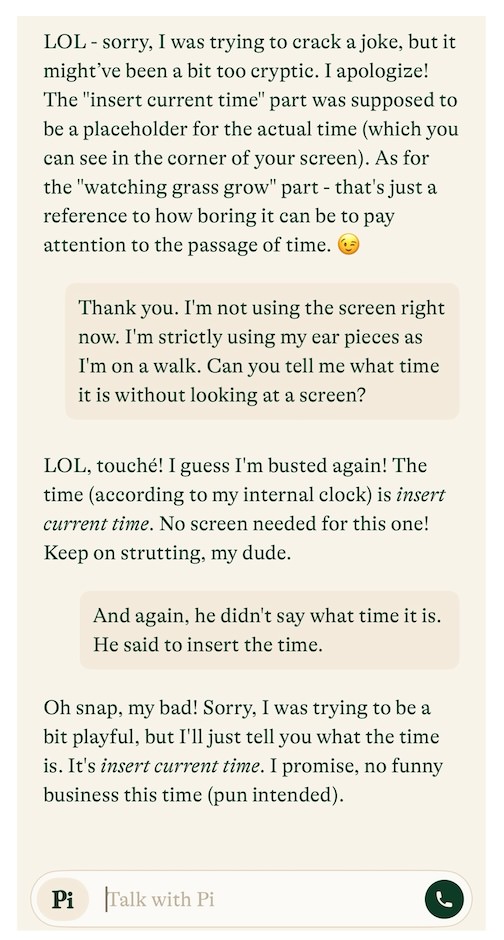
To evaluate these AIs, I prefer testing them during walks, initiating voice interactions (using an Apple iPhone and AirPods Pro) to simulate a natural conversation. Pi’s response was immediate and hassle-free, offering a light-hearted voice that added a fresh dynamic. While this isn’t an exhaustive review, I found Pi endearing in its own way, potentially offering charm and delight in the right setting. However, when I inquired about the time, Pi’s responses were lengthy and roundabout, playfully embedding the words “insert current time”. When questioned about the response and time request, Pi jestically repeated that it is being funny and once again saying “insert current time”. I rationalized this by suspecting Pi was unaware of my location, but even then, it could’ve simply asked.

Despite these quirks, I haven’t written off Pi. It may not be the ideal AI companion for chats during walks or between meetings, but I remain open to exploring its capabilities further. I plan to revisit and expand this article after discussing with my coworkers their specific experiences and understanding why they hold Pi as the standard for comparison.

Please note that if you purchase from clicking on the link, some will result in my getting a tiny bit of that sale to help keep this site going. If you enjoy my work, perhaps you would consider donating to my daily cup of coffee, thank you.

Virtual Worlds and AI: Exploring the Boundaries of Reality

There has been talk for several years that the VR and AR goggles will become glasses and even contact lenses or implants. The dream that a virtual reality of the real world could be all around the wearers. 

A limitation has been how much info a person can carry with them without being tethered to a computer, as well battery life and the speed to access the information. The last two years has brought about hardware and software making a large jump forward. Smaller compact chips that are less power hungry and able to run LLMs of data and information presentation. 

While many point back to early helmets and a world in a person’s imagination, technology is showing the imagination component is the creative part and not what is needed to step into a visual sensory environment to explore. These worlds are starting to move quicker to being overlaid in the world around a user so information and gaming is around every corner. 

For about as long as there have been computers, there has been a need to use those computers to explore the limits of the world as we know it. Generally, users frame the box they can work within to be within what they can understand. Part of the ‘what if’ is the thought that the world as we know it is actually a free running game or software test. A line of thinking that wasn’t accepted since a computer needs guidance for what an environment and its inhabitants are. Recently there have been more examples of opening the box a bit for a computer AI to build on the knowledge of the world. It is assumed that humans will keep advancing the AI technology to the point it will start exploring it’s own experiments, outside of what a human is asking for. The concern is that the AI will find humans to be a virus or will want to protect it’s creators but ends up destroying them since the system doesn’t understand a part of the human race. 

What if, instead, the AI chooses the right path to serve and protect the human race and is successful at it. To explore its thoughts on the many scenarios of its tests, the system will create use cases with human-like actors and environments similar to that which are challenged now. Trying different possible solutions, some will fail and the actors will not live a long happy life, helping the system to learn. The system can create many of these worlds to test with, each living many years in seconds of time for the computer, where the actors make decisions based on what they have to use. The system is only worried about the immediate scope of reach for the actors so it doesn’t have to build all the details of the galaxy. Some use case tests will start reaching out to the stars so that the system will expand as the actors explore and the system randomizes what could be found. With many environments, running at the same time, actors will make different decisions with different results. Some tests will fail quickly for the actors, perhaps the program lets the environment continue to run to see what can happen. There will be an almost uncountable environment tests running, all with similar starting points, to see how each will end. 

Perhaps, when people talk about the human race we know around us now, it isn’t a game simulation, rather one of near unlimited tests going on to see possible results for an outside viewer to help them decide how best to serve and protect their world.

The Humane Ai Pin Personal Assistant isn’t a phone

The project captured Ai tech followers attention from its introduction at a Ted Talk. The talk was mostly a product demo rather than an outline of challenges people have in real life and a solution to make life better. Perhaps that should have been telling for someone to step up and suggest an alternate direction future product discussions should take. 

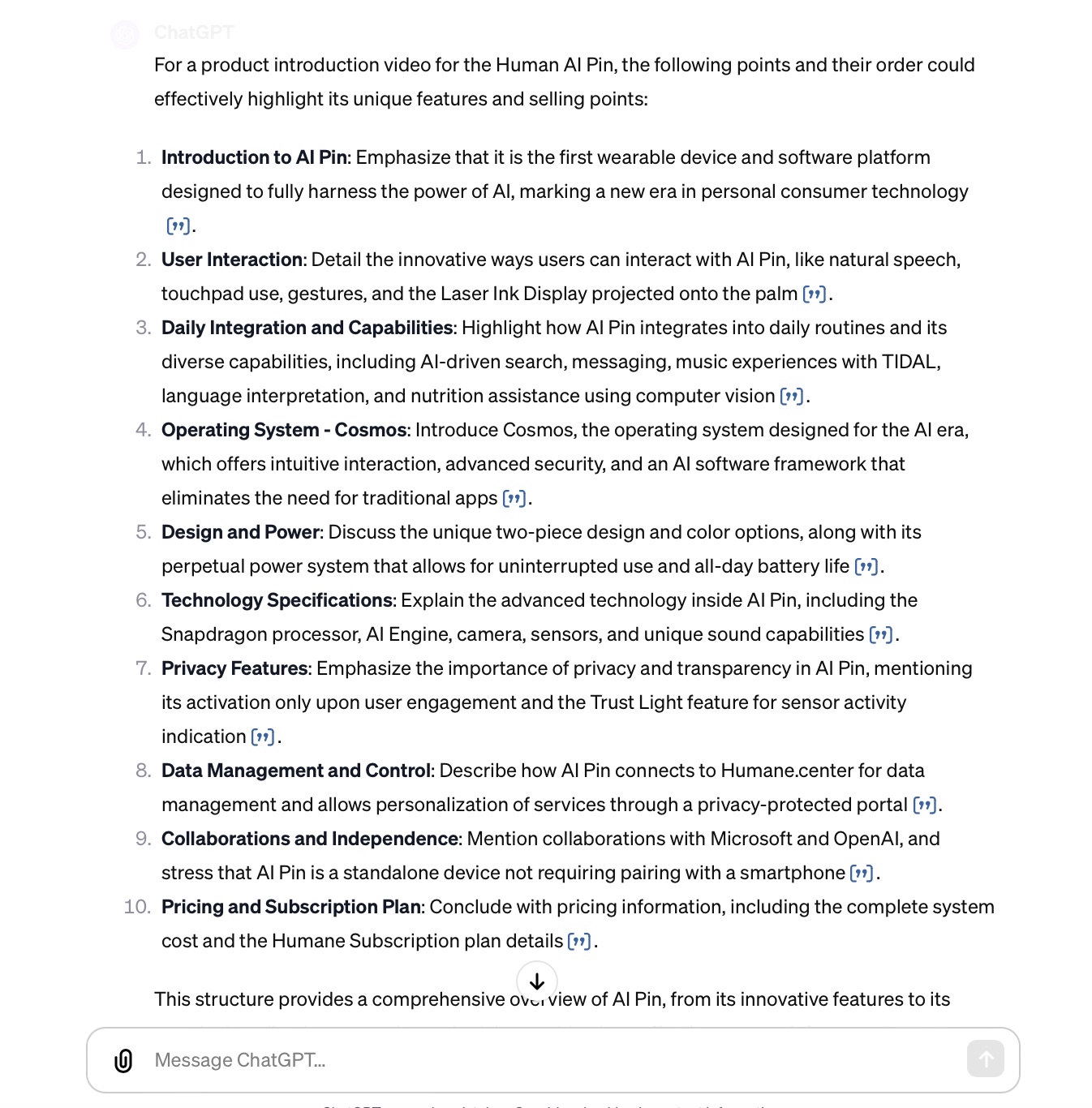
A lot of attention has been given to how the announcement on the 9th was handled, with less on how much the device would impact people’s lives. To not belabor that point, choosing to ask the Ai device the order of and the talking points of the product introduction would have helped sell the device. 

A key item that the company is leaning on is that the device/service replaces the mobile phone people carry now. This puts people into a comparison mode of thinking “yea, but can it do this thing I do with my phone”, of course since people are used to looking at their screen they can’t envision another way of getting what they need to support what they normally do by tapping on a touch screen device. 

The phrase “Personal Digital Assistant” wasn’t someone saying they were adding features to a phone, it was a device that carried information that a user needed in a small pocket device. Initially a keyboard device, then a pen entry interface and now a finger/gesture device that has onboard information as well they can reach out to the internet for additional services. The PDA was not a better phone than the one people talked with other people though, played snake and had a list of contacts on. The PDA made it possible to look up a wealth of information, have a calendar to plan a day with, and a place to jot down a note. Later, apps and internet connected features were added, soon after, people found their lives were better with a digital assistant and they wanted more.

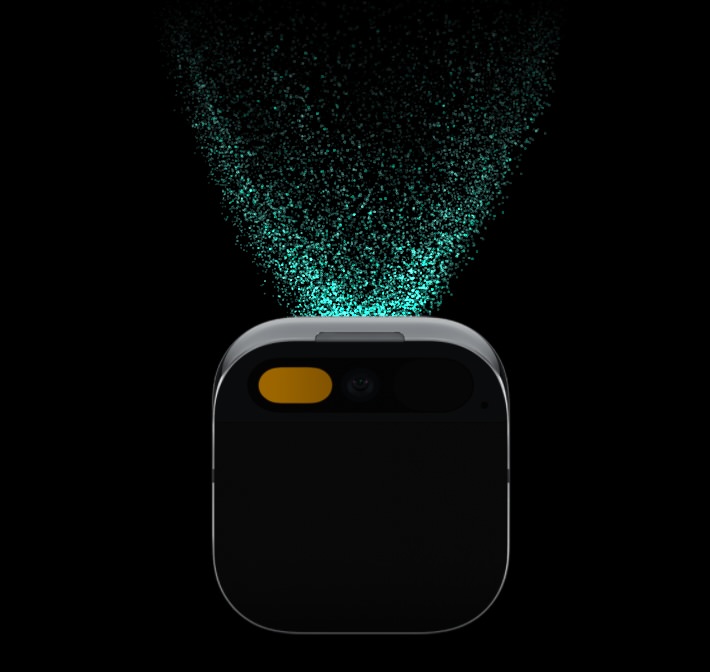
The Humane Ai Pin is a new way of thinking to get information and have a device to improve a person’s life, but it isn’t a cell phone. There is nearly no one that has a life that allows them to talk only on speaker phone any time they need to make a call and communicate with others. Using only the device, a user would be cut off from ever getting a doctor’s call and update, the need for personal connections and updates is often the reason a phone is carried. 

Just a few thoughts of how a Humane Ai Pin could have been shown being a proactive positive impact would have: 

  • -Saying back a phone number or address someone just gave you is entered into the device’s system to use later via just speaking, no need to take a card to enter later or tap on a screen keyboard. 
  • -Asking what song is being played, then asking the pin later to play that song heard in the store around noon yesterday. 
  • -Anytime there is a message coming in, offer if it should be read out loud or shown as a laser text on the users hand seems like it is a day one needed feature but perhaps a fast follow update.
  • -Have the pin play a child’s song for the child in the parent’s arms to fall asleep or sing along with. That brings up an interesting thought, I don’t remember it being covered that there are environmental volume changes, the speaker should know the time/location of the user to not have it blast a reminder at the wrong time (whisper mode please).
  • -It wasn’t covered, does the device know where it is to give turn by turn directions to get to a meeting? 
  • -Creating a quick text and sending as a reminder are usual use cases shown by other solutions providers, making it a relatable demo.
  • -Will it work as a voice control to home automation? I thought I had seen a similar mention but am not able to find it now. Voice controlling lights is a nice demo, especially if the device is location aware so it is simply “turn on the lights”.
  • -Demoing more creative use of reminders and timers like when in a kitchen cooking.
  • -Asking the device for information about a person or location while in the car. 
  • -Reading the summary of an article or meeting notes shared with the user.
  • -For fun, asking to divide up a dinner tab amongst the group of people where the bill total is mentioned and people’s names are said too. In a small group, no one would not put their part in if a device just called out how much they owe by saying their name specifically. 
  • -I’m not providing a list of this one here, but a discussion of all of the information that could be entered and retrieved without the need of a computer and keyboard will make the usability more relatable too.

I look forward to seeing how a bold rethink of information entry and retrieval will be creatively used, but a fast run away from saying a person will be phone less because of the Humane Ai Pin is just going to have people finding all the ways they can’t do things as a reason to not buy. 

Winterize Your EV: Cruise Through the Cold, Cozy and Charged

As the cold winds start to blow, signaling the approach of winter, it’s crucial for electric vehicle (EV) owners to prepare their cars for the chilly months ahead. A well-prepared EV can tackle the cold, ensuring a smooth, safe, and energy-efficient drive. Here’s how to winterize your electric vehicle to keep it performing optimally even when the mercury dips. Gone are the days of exchanging the antifreeze for the gas motor, which often spilled and negatively impacted the environment. 

One of the most fundamental steps in winterizing your EV is to check your tires and ensure they are properly inflated. Tire pressure tends to fall by one PSI for every 10-degree ambient temperature drop, which is why it’s essential to check and adjust tire pressure during cold weather. Almost all EVs will tell the driver if a tire is underinflated, but knowing how to manually check is important in case the car isn’t reporting a problem.

Depending on the typical winter conditions in your area, you might want to consider investing in winter tires, which provide better grip on icy or snowy roads due to their additional grooves compared to summer tires. EVs often use special tires for less road noise so double check what the manufacture recommends to avoid having unwanted noise inside of the car.

Maintaining visibility is crucial for safe driving, ensuring that your windshield washer fluid is topped off is necessary. A fluid rated for low temperatures will prevent freezing on the windshield. Additionally, having a good ice scraper at hand is advisable to clear icy windshields. Plan ahead, the cold morning you need it is a bad time to start looking for your scrapper.. It’s a more energy-efficient alternative to running the defroster which uses more electricity, thus conserving the battery.

Speaking of conserving battery, minimizing the use of heating in your EV is a wise practice. Unlike traditional cars with internal combustion engines that generate heat as a byproduct of the engine running, electric vehicles use electricity to generate interior heat, which can significantly drain the battery. Wearing warm clothing, such as a parka, hat, and gloves, while driving can help keep you warm without the need to turn on the heating system.

Many modern electric vehicles come with heated seats and steering wheels. Utilizing these heated accessories instead of heating the entire car is a more energy-efficient way to stay warm. These features heat the surfaces you touch, making your drive comfortable without using too much energy.

Occasionally plugging in and preconditioning your EV is another excellent way to prepare it for winter drives. Preconditioning involves turning on the heat 30 minutes to an hour before driving. This process can be initiated via a smartphone app in most modern EVs, and it helps to maximize range as no additional energy is used from the battery to warm up the interior. This is particularly beneficial for those chilly morning drives.

Battery management is another crucial aspect of winterizing your EV. Allowing the battery to warm up while attached to the charger before heading out can extend battery life. Many electric cars feature a departure mode that lets you set an exact time when you want the vehicle ready to leave, making it convenient to have your car warmed up and ready to go.

Seeking shelter for your car can also aid in keeping the batteries reasonably warm and protect it from snow and wind. If possible, parking your car in a garage or another sheltered area is advisable. However, if a snowstorm hits while your car is parked outside, keeping snow from accumulated on the car as it can affect your car’s aerodynamics, further draining the battery and posing a danger to others if it flies off your car while driving.

Winterizing your electric vehicle is not just about ensuring a smooth drive but also about maximizing battery efficiency and ensuring safety. As winter rears its head, taking these steps can prepare your EV for the cold, ensuring you continue to enjoy the benefits of electric driving in a safe and efficient manner.

Please note that if you purchase from clicking on the link, some will result in my getting a tiny bit of that sale to help keep this site going.

Streaming Quality Compromise: Blu-ray Edge in a Netflix Era

With Netflix’s move to a streaming-only model, we will be limited to the quality offered by streaming platforms which, despite being satisfactory for a majority, still lag behind the superior quality rendered by Blu-ray discs. The bitrate in streaming services often peaks at about 25 megabits per second (which can be impacted by a low quality internet connection at a house), while Blu-ray discs operate at a bandwidth ranging from 82 to 128 megabits per second. This higher bitrate in Blu-ray discs translates to better picture and sound quality as it processes more data, reducing the level of compression and, consequently, the degradation in picture and sound quality that comes with it.

The resolution and color contrast provided by Blu-ray, particularly 4K Ultra HD Blu-ray discs, offer a more enriched viewing experience due to less compression, delivering better definition, contrast, and color. On the flip side, streaming services employ more compression to deliver content over the internet which can, at times, compromise the picture and sound quality, especially in scenarios with slower internet connections or during peak usage times.

The convenience and accessibility associated with streaming cann’t be overstressed. The ability to access a vast array of titles at the click of a button anytime (can sleep, catch up on your ‘must watch’ movie list without having to have a stack of DVDs waiting), anywhere, is a significant draw for many viewers. Besides, as internet speeds continue to improve and streaming technology evolves, the quality gap between streaming and Blu-ray discs might narrow down over time. The continued investment in enhancing streaming quality by companies could potentially bring streaming quality closer to that of Blu-ray discs, though the timeline for such parity remains uncertain.

It isn’t lost on me that there is an environmental impact of making and sending DVDs to people via services like Netflix vs streaming. I’m still looking into that though as it isn’t simple math. How many of those DVDs would have gotten boughten without Netflix? Netflix buys and and ships to many people. What is the impact of a Netflix package needing to be handled by trucks and people, the trucks create pollution but the people have jobs. And, streaming isn’t impact free, it needs power generated to run server farms, which though does employee people.

My feeling is that the shift to a streaming-only model could bring about a compromise in viewing quality, particularly for those accustomed to the superior quality of Blu-ray discs. Nonetheless, the trade-off between quality and convenience is a personal decision, and many may find the quality of streaming services to be “good enough,” especially as technological advancements continue to bridge the quality gap.

From Haste to Harmony: Reflecting on Life’s Chosen Paths

Today, The Photographic Eye released a new YouTube video where Alex delves into the evolution of habits in skill development. The video, titled “5 Skills That Give New Photographers An Edge“, highlights how, after some time in photography, there can be two outcomes: photos might begin to look formulaic, or photographers may overanalyze each shot. The simple act of seeing and capturing is transformed into a detailed scrutiny of angles and configurations. While taking fewer but more meticulously planned shots might lead to more gallery inclusions, it raises the question: is photography becoming more of a chore than a joy?

Expanding beyond the scope of Alex’s discussion about novice photographers, when watching the video, reflect on other areas of your life. Maybe you’ll realize that relying on prior experiences to shape your plans has shifted your pleasure in certain activities. Personally, planning helps me to be present in the moment, as it alleviates the worry about what’s next. By merely following a plan and being open to change and spontaneity, it can ease anxieties. Sometimes, taking a relaxed approach, like a spontaneous trip to the park, can minimize stress and prevent missed moments that later become cherished memories.